Oh man! The actual Burger Time game, rather than Super Burger Time! I would love to get this, but we'll have to wait until CERO re-opens to rate games.
@brunojenso The Jet Lancers beta was way more brutal for me. At least Luftrausers is a game played in bursts as it's a game that never stops. Whilst Jet Lancers is level based with progression and boss battles. The issue I had with the beta was that I found the levels really tough, but the boss level they sent was reasonable.
I was a part of their beta test, it's a great game, but the levels they gave me were brutally hard, hopefully they've balanced out the difficulty of the game to make it challenging rather than dying really quickly!
Oh awesome! This game was great, not only on the Arcades, but both the SNES and MegaDrive ports were great fun too, despite only giving a 2 player mode rather than the 4 player mode in the arcade version.
Oh man, I remember playing Pocky and Rocky 1 & 2 on the SNES. This is the first game on the arcades, it might be worth trying out for some Yokai zapping action!
Is the input lag on the other Zero-Div Psikyo games? Or is it a problem with the compilation?
I was planning to get this compilation, but I'm kinda glad that I canceled my preorder now. BUt I canceled it at the time because I couldn't afford it at the time.
But IMO I can't play a, Shock, game with a controller these day. It has to be Mouse and Keyboard for me! I'm eagerly awaiting the System Shock 1 remake and System Shock 3!
Balloon Fight Vs. was a network game, as in, it used 2 seperate cabinets when playing in multiplayer. I'm hoping that this either have online multiplayer, or a local wireless mode to emulate the game's network multiplayer function.
@RetiredR I looked at this image carefully, and used Photoshop and GIMP to change the exposure and contrast. We might be in luck as I can tell there's a screen edge in this photo, which confirms that GBA game will use letterboxing in order to keep the aspect ratio correct.
@sdelfin An ASIC is practically a system on a chip that's pre-configured. But a FPGA is programmable, meaning you get put an details of how a system works onto it, then change it on the fly. Granted there's a loading time for that, but the beauty of this piece of kit is that there's two of them. One designed for the GameBoy hardware, and another for either the Lynx, NeoGeo Pocket, GameGear and possibly any other 8 and 16 bit system after a custom firmware update.
@InAnotherCastle If it works with the GameBoy, it'll work with this. Granted the GameGenie is pretty big, and it'll hulk over this piece of kit! lmao!
Plus, from what I remember, GameBoy Color game act very weird when you use a GameGenie, so I don't think it'll be worth it. But the idea is that as this uses FPGA rather than emulation, whatever the GameBoy does, this works exactly like it too.
@brunojenso Not to mention the screen on this thing is nearly twice the pixel density of the iPhone 11. A little OOT for a system to run Portable games, but the reason behind it is that it can run both GameBoy (Color) and GameBoy Advance games on the same screen without having to stretch the screen and cause Nearest-neighbor interpolation, which makes the game look blurry than the real hardware. For GameBoy games, it'll use 10*10 pixels to make one pixel in a game, whilst GBA games will have 6*6 pixels per in-game pixel so that it looks razor sharp, that's calle Integer scaling. I don't know the resolution of the other systems, but by having that huge resolution display, the other formats will look sharp too by using integer scaling rather than NN-interpolation. @KingMike @N64-ROX
@StevenG There will be separate adapters for the Analogue Pocket for the other non-GameBoy carts. Then the second FPGA will get that system and load the game up.
@brunojenso An FPGA, a field-programmable gate array, is a means to turn emulation software into an actual hardware piece of kit, and act as a system on a chip, like what the XBoxOne X uses.
The Super NT, and the Mega SG, the SNES and MegaDrive consoles that Analogue make as well, use FPGAs to make the system work like a SNES/MegaDrive at a hardware level rather than just using emulators, which can be not as accurate as the real hardware. To make things aware, a single FPGA chip are not cheap compared to other chips and ICs, sure, they're not Intel i9 prices, but from a manufacturing point of view, they're going to be the priciest thing in this system, and there's TWO of them in the Analogue Pocket.
The idea behind the Analogue Pocket's two FPGA chips is that it can run more than one system on a single piece of kit. Because this system can run GameBoy (Color/Advance), GameGear, Lynx, and NeoGeo Pocket games, through adapters. The second FPGA can be used to run those games at hardware level too rather than emulation, meaning they too can be run as accurately as possible without the needs of another single FPGA system. Simply put, the first FPGA will have the GameBoy system loaded onto it, whilst the second can be loaded with pretty much any other system to it, meaning that we could get crazy adapters for this thing that could run SNES/MegaDrive games and treat it like a modern Sega Nomad!
@smithpa01 because it can play Lynx, GameGear and NeoGeo Pocket Color carts (with adapters) too.
Not to mention that it's a technical marvel with two FPGA chips, an insanely high pixel density display, and that there's a TV dock coming out for it too.
I'd love to get this just for the 8 player version of Pengo that's on it. But getting this from PlayAsia, along with paying for shipping and customs, it suddenly becomes a pricey investment!
It's almost as bad as getting imports from the nineties!
Man! This was the second video game I ever played when I went to Caister-on-Sand when I was 5 years old!
For some reason, the Haven Holiday camp had about 3 or 4 Two Player Karate Champ machines dotted around the camp, and each time I saw one, I would beg my grandad to put a 10p piece (The older bigger coin compared to what you get today) so that I can play the game, though I doubt I was any good at it at 5 years old! lol!
@Toy_Link That's because the arcade game uses two sticks per person. Yeah, a Twin Stick fighting game!
Moves are performed by pushing the sticks into certain directions. But if you move just the Left stick you move, and moving the right stick performs blocks at certain heights.
I love playing the PC versions of the Elite Sniper games.
To be brutally honest, I'm not likely to play the Switch versions. But if people only own a Switch, then by all means find a way to play these games on your Switch. They're great stealth/TPS/FPS games!
If Rebellion announce a 5th Sniper Elite game, I know it'll get my attention!
@60frames-please However, the reason that I didn't get the PC version of Untitled Goose Game is because it became an Epic Store exclusive and I hate running so many damn launchers on my PC.
I leave my PC only ever running Steam and GOG, there's no point in wasting RAM for launchers.
@tendonerd But the Apple TV is a set top box right?
I doubt that's the TV forcing the set top box to run at that, it might be a setting on the Apple TV to run at that rate. Heck, the PS3 does have 24hz mode for cinema rate bluray.
But all TVs these days, even since 2000, support up to 60Hz. I haven't seen a 50hz only TV set since the late 90s.

Comments 643
Re: Mini Review: Jet Lancer - Outrageously Enjoyable Aerial Combat Action
@NinChocolate Luftrausers?
Though, the UFOs come out much later in the game.
Re: Mini Review: Jet Lancer - Outrageously Enjoyable Aerial Combat Action
Sounds like it's MUCH better than the beta I tried out. Now I'm very tempted to get this game!
Re: Talking Point: What Are You Playing This Weekend? (May 9th)
ANimal Crossing, Streets of Rage 4 (On Xbox PC gamepass) and Lonely Mountain Downhill (On XBox PC Gamepass too.)
Re: Talking Point: Should Nintendo Create An Apple Arcade-Style Service For Smartphones?
Simple answer, yes.
Will Nintendo do it, no.
They're way too stubborn to do it. They'll let Microsoft games come their platform, but the XBoxOne has yet to see a Nintendo game appear on it!
Re: Random: Do You Know About Super Mario Bros.' Secret Game Over Continue Trick?
Heh, I did know about the SMB1 continue trick. I read about it in a book years-and-years ago!
Re: Hamster Is Adding A Handful Of Data East Classics To The Arcade Archives
Oh man! The actual Burger Time game, rather than Super Burger Time! I would love to get this, but we'll have to wait until CERO re-opens to rate games.
Re: Switch Shooter Jet Lancer Mixes Dog Fighting, Giant Robots And Advance Wars-Style Visuals
@brunojenso The Jet Lancers beta was way more brutal for me. At least Luftrausers is a game played in bursts as it's a game that never stops. Whilst Jet Lancers is level based with progression and boss battles. The issue I had with the beta was that I found the levels really tough, but the boss level they sent was reasonable.
Re: Switch Shooter Jet Lancer Mixes Dog Fighting, Giant Robots And Advance Wars-Style Visuals
Great game! Reminds me a lot of Luftrausers.
I was a part of their beta test, it's a great game, but the levels they gave me were brutally hard, hopefully they've balanced out the difficulty of the game to make it challenging rather than dying really quickly!
Re: SNK Gals Fighters Gets Rated For The Nintendo Switch In South Korea
Now I want a Joycon with a mechanical switch dpad like the NGP and NGCD!
Re: Feature: Why We Think Crazy Redd Will Bring His Artwork To Animal Crossing: New Horizons
I reckon that Redd will appear, but I believe that the next floor in the museum will be for Celeste to her her astronomy.
Re: Talking Point: What Are You Playing This Weekend? (April 4th)
Animal Crossing New Horizons,
Octopath Traveller,
and Doom Eternal (on the PC, sure that's not a Switch game, but I will be playing it!)
Re: Hideki Kamiya Explains PlatinumGames' Disappointing April Fools' Joke
@EmirParkreiner Hell yeah!
After all, Pokemon Go originated from an April's fool day joke right?
I love Moon Cresta and Terra Cresta, I really do hope this becomes a real product in the future!
Re: PlatinumGames' Fourth Reveal Turned Out To Be An April Fools' Joke
I would totally get that!
But it's not real!
Re: Atari's Arcade Classic Pong Comes To Switch As An RPG
Pong without rotary controls doesn't work.
Plus, do we need a Pong game that has RPG elements?
Re: Konami's Cowboy Classic Sunset Riders Is Galloping To Switch Soon
Oh awesome! This game was great, not only on the Arcades, but both the SNES and MegaDrive ports were great fun too, despite only giving a 2 player mode rather than the 4 player mode in the arcade version.
Re: LEGO Super Mario Officially Unveiled, Features Interactive Mario And Fan-Favourite Characters
WOW...
I actually used to make Mario levels with Lego as a kid. My inner child desires this! lmao!
Re: Hamster Adds Taito's 1986 Action Shoot 'Em Up KiKi KaiKai To The Arcade Archives
Oh man, I remember playing Pocky and Rocky 1 & 2 on the SNES. This is the first game on the arcades, it might be worth trying out for some Yokai zapping action!
Re: Review: Psikyo Shooting Stars Bravo - A Fine Shmup Selection, But Input Lag Remains An Issue
Interesting...
Is the input lag on the other Zero-Div Psikyo games? Or is it a problem with the compilation?
I was planning to get this compilation, but I'm kinda glad that I canceled my preorder now. BUt I canceled it at the time because I couldn't afford it at the time.
Re: King Lucas Is A Platformer Inspired By Retro Classics, And It's Out On Switch This Week
The game might be pretty good, as it reminds me of Lode Runner and Spelunker. But man... that art style looks bad though! lol!
Re: BioShock: The Collection Could Be Coming To Switch According To New Rating
Very cool.
But IMO I can't play a, Shock, game with a controller these day. It has to be Mouse and Keyboard for me! I'm eagerly awaiting the System Shock 1 remake and System Shock 3!
http://systemshock.com/
https://otherside-e.com/wp/games/system-shock-3/
P.S. System Shock 2 is the best, Shock, game! ;P
Re: Hamster Is Bringing VS. Balloon Fight To The Switch eShop Next Week
Awww... This sucks, looks like there's no online, or wireless local multiplayer. Rather it splits the screen for each player...
Boo...
https://twitter.com/game_watch/status/1207639490681982976
Re: Hamster Is Bringing VS. Balloon Fight To The Switch eShop Next Week
Nice! But...
Balloon Fight Vs. was a network game, as in, it used 2 seperate cabinets when playing in multiplayer. I'm hoping that this either have online multiplayer, or a local wireless mode to emulate the game's network multiplayer function.
Re: Hey Nintendo, Can We Please Have Famicom Wars?
I still think Nintendo needs to localise the Famicom Wars games and call them "Nintendo Wars".
Re: Random: This Switch Game Manual Has Controls For The Wrong Platform
Yup, when I received my copy of this, mine came with a manual for the PS4 controls in it! lol!
Re: Who Needs A Game Boy Classic Edition When You've Got The Analogue Pocket?
@RetiredR I looked at this image carefully, and used Photoshop and GIMP to change the exposure and contrast. We might be in luck as I can tell there's a screen edge in this photo, which confirms that GBA game will use letterboxing in order to keep the aspect ratio correct.
Re: Who Needs A Game Boy Classic Edition When You've Got The Analogue Pocket?
@sdelfin An ASIC is practically a system on a chip that's pre-configured. But a FPGA is programmable, meaning you get put an details of how a system works onto it, then change it on the fly. Granted there's a loading time for that, but the beauty of this piece of kit is that there's two of them. One designed for the GameBoy hardware, and another for either the Lynx, NeoGeo Pocket, GameGear and possibly any other 8 and 16 bit system after a custom firmware update.
Re: Who Needs A Game Boy Classic Edition When You've Got The Analogue Pocket?
@HalBailman You know this plays GBA games right?
Not to mention it plays other formats like Lynx and NeoGeo Pocket games with adapters.
Re: Who Needs A Game Boy Classic Edition When You've Got The Analogue Pocket?
@infernogott They're next to the cartridge connector.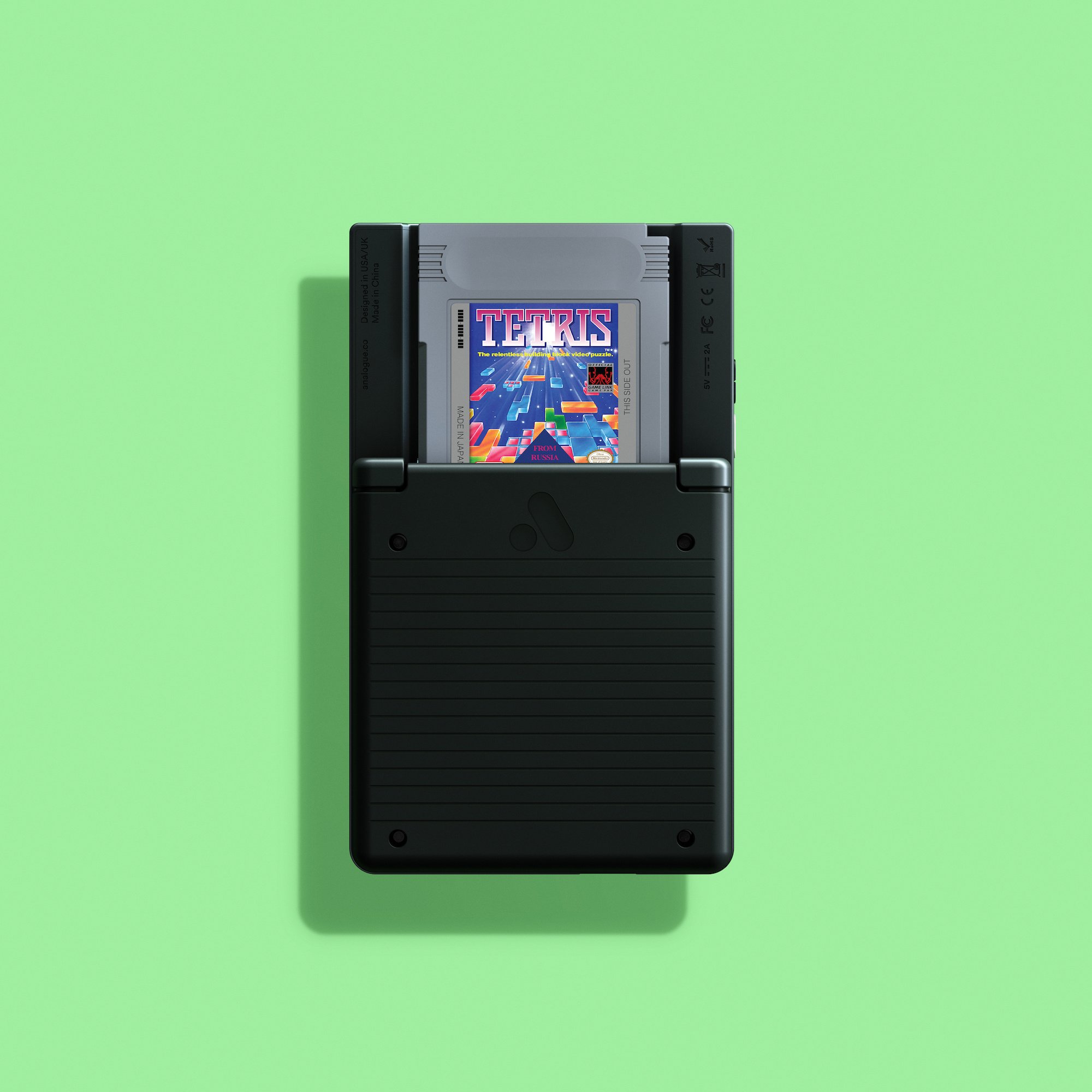
They're similar to the shoulder buttons on the GBA SP.
Re: Who Needs A Game Boy Classic Edition When You've Got The Analogue Pocket?
@Tempestryke Here's a Pocket next to a Advance. https://photos.app.goo.gl/1XnUHdJzdooeeSs88
Re: Who Needs A Game Boy Classic Edition When You've Got The Analogue Pocket?
@InAnotherCastle If it works with the GameBoy, it'll work with this. Granted the GameGenie is pretty big, and it'll hulk over this piece of kit! lmao!
Plus, from what I remember, GameBoy Color game act very weird when you use a GameGenie, so I don't think it'll be worth it. But the idea is that as this uses FPGA rather than emulation, whatever the GameBoy does, this works exactly like it too.
Re: Who Needs A Game Boy Classic Edition When You've Got The Analogue Pocket?
@brunojenso Not to mention the screen on this thing is nearly twice the pixel density of the iPhone 11. A little OOT for a system to run Portable games, but the reason behind it is that it can run both GameBoy (Color) and GameBoy Advance games on the same screen without having to stretch the screen and cause Nearest-neighbor interpolation, which makes the game look blurry than the real hardware. For GameBoy games, it'll use 10*10 pixels to make one pixel in a game, whilst GBA games will have 6*6 pixels per in-game pixel so that it looks razor sharp, that's calle Integer scaling. I don't know the resolution of the other systems, but by having that huge resolution display, the other formats will look sharp too by using integer scaling rather than NN-interpolation. @KingMike @N64-ROX
Re: Who Needs A Game Boy Classic Edition When You've Got The Analogue Pocket?
@Sgt-Jack-V They're putting Nanoloop onto it, a ChipTune music production software.
Re: Who Needs A Game Boy Classic Edition When You've Got The Analogue Pocket?
@StevenG There will be separate adapters for the Analogue Pocket for the other non-GameBoy carts. Then the second FPGA will get that system and load the game up.
Re: Who Needs A Game Boy Classic Edition When You've Got The Analogue Pocket?
@brunojenso An FPGA, a field-programmable gate array, is a means to turn emulation software into an actual hardware piece of kit, and act as a system on a chip, like what the XBoxOne X uses.
The Super NT, and the Mega SG, the SNES and MegaDrive consoles that Analogue make as well, use FPGAs to make the system work like a SNES/MegaDrive at a hardware level rather than just using emulators, which can be not as accurate as the real hardware. To make things aware, a single FPGA chip are not cheap compared to other chips and ICs, sure, they're not Intel i9 prices, but from a manufacturing point of view, they're going to be the priciest thing in this system, and there's TWO of them in the Analogue Pocket.
The idea behind the Analogue Pocket's two FPGA chips is that it can run more than one system on a single piece of kit. Because this system can run GameBoy (Color/Advance), GameGear, Lynx, and NeoGeo Pocket games, through adapters. The second FPGA can be used to run those games at hardware level too rather than emulation, meaning they too can be run as accurately as possible without the needs of another single FPGA system. Simply put, the first FPGA will have the GameBoy system loaded onto it, whilst the second can be loaded with pretty much any other system to it, meaning that we could get crazy adapters for this thing that could run SNES/MegaDrive games and treat it like a modern Sega Nomad!
Re: Who Needs A Game Boy Classic Edition When You've Got The Analogue Pocket?
@Tempestryke It's about the same size as a GameBoy Pocket.
Re: Who Needs A Game Boy Classic Edition When You've Got The Analogue Pocket?
@Zorox88 Two FPGA chips and a 1600*1440 pixel display isn't going to cost $70.
Re: Who Needs A Game Boy Classic Edition When You've Got The Analogue Pocket?
@smithpa01 because it can play Lynx, GameGear and NeoGeo Pocket Color carts (with adapters) too.
Not to mention that it's a technical marvel with two FPGA chips, an insanely high pixel density display, and that there's a TV dock coming out for it too.
Re: Who Needs A Game Boy Classic Edition When You've Got The Analogue Pocket?
@Paperboy You'll need adapters for Lynx and NGPC games, but it will be possible with the system's dual FPGA system.
Re: Who Needs A Game Boy Classic Edition When You've Got The Analogue Pocket?
@Smash_kirby Yes, there's a link cable port, but it's on the bottom of the system next to the USB-C and Headphone jack.
Re: Talking Point: What Are You Playing This Weekend? (October 12th)
I've been trying to keep up with Link's Awakening. But I got myself Killer Queen Black on Steam, and I've been hooked to it!
Re: Review: Arcade Love: Plus Pengo! - A Unique Bundle Of Japanese Zaniness
I'd love to get this just for the 8 player version of Pengo that's on it. But getting this from PlayAsia, along with paying for shipping and customs, it suddenly becomes a pricey investment!
It's almost as bad as getting imports from the nineties!
Re: Animal Crossing: New Horizons, Luigi's Mansion 3 And More To Be Featured At Nintendo Live 2019
Wait...
Is this a new Space World event?
Re: Train Up And Compete In Hamster's Latest Arcade Archives Release Karate Champ
Man! This was the second video game I ever played when I went to Caister-on-Sand when I was 5 years old!
For some reason, the Haven Holiday camp had about 3 or 4 Two Player Karate Champ machines dotted around the camp, and each time I saw one, I would beg my grandad to put a 10p piece (The older bigger coin compared to what you get today) so that I can play the game, though I doubt I was any good at it at 5 years old! lol!
Re: Train Up And Compete In Hamster's Latest Arcade Archives Release Karate Champ
@Toy_Link That's because the arcade game uses two sticks per person. Yeah, a Twin Stick fighting game!
Moves are performed by pushing the sticks into certain directions. But if you move just the Left stick you move, and moving the right stick performs blocks at certain heights.
Re: Review: Sniper Elite 3 Ultimate Edition - Gratuitous Gore And Dumb AI Can't Ruin This Likeable Shooter
I love playing the PC versions of the Elite Sniper games.
To be brutally honest, I'm not likely to play the Switch versions. But if people only own a Switch, then by all means find a way to play these games on your Switch. They're great stealth/TPS/FPS games!
If Rebellion announce a 5th Sniper Elite game, I know it'll get my attention!
Re: Guide: Where To Buy The Nintendo Switch Online Super NES Controllers
I don't see nintendo.co.uk's page update for purchasing the pads. Did I miss out on that?
Re: Untitled Goose Game Is Out Now, And You Can Buy It Cheap For A Limited Time
@60frames-please However, the reason that I didn't get the PC version of Untitled Goose Game is because it became an Epic Store exclusive and I hate running so many damn launchers on my PC.
I leave my PC only ever running Steam and GOG, there's no point in wasting RAM for launchers.
Re: Untitled Goose Game Is Out Now, And You Can Buy It Cheap For A Limited Time
@60frames-please Yeah, I pretty much do roughly the same thing. If it's better on a PC, I would just get a PC version.
Then, providing that the game isn't overly-over the top, and/or inefficient, can play them at unlocked frame rates, and play games at 140fps! ;P
Re: Untitled Goose Game Is Out Now, And You Can Buy It Cheap For A Limited Time
@tendonerd But the Apple TV is a set top box right?
I doubt that's the TV forcing the set top box to run at that, it might be a setting on the Apple TV to run at that rate. Heck, the PS3 does have 24hz mode for cinema rate bluray.
But all TVs these days, even since 2000, support up to 60Hz. I haven't seen a 50hz only TV set since the late 90s.
Re: Untitled Goose Game Is Out Now, And You Can Buy It Cheap For A Limited Time
@tendonerd It would have to be a cheap CRT from the 80s/very early 90s.
Pretty much all flat panel TVs support up to 60hz.