
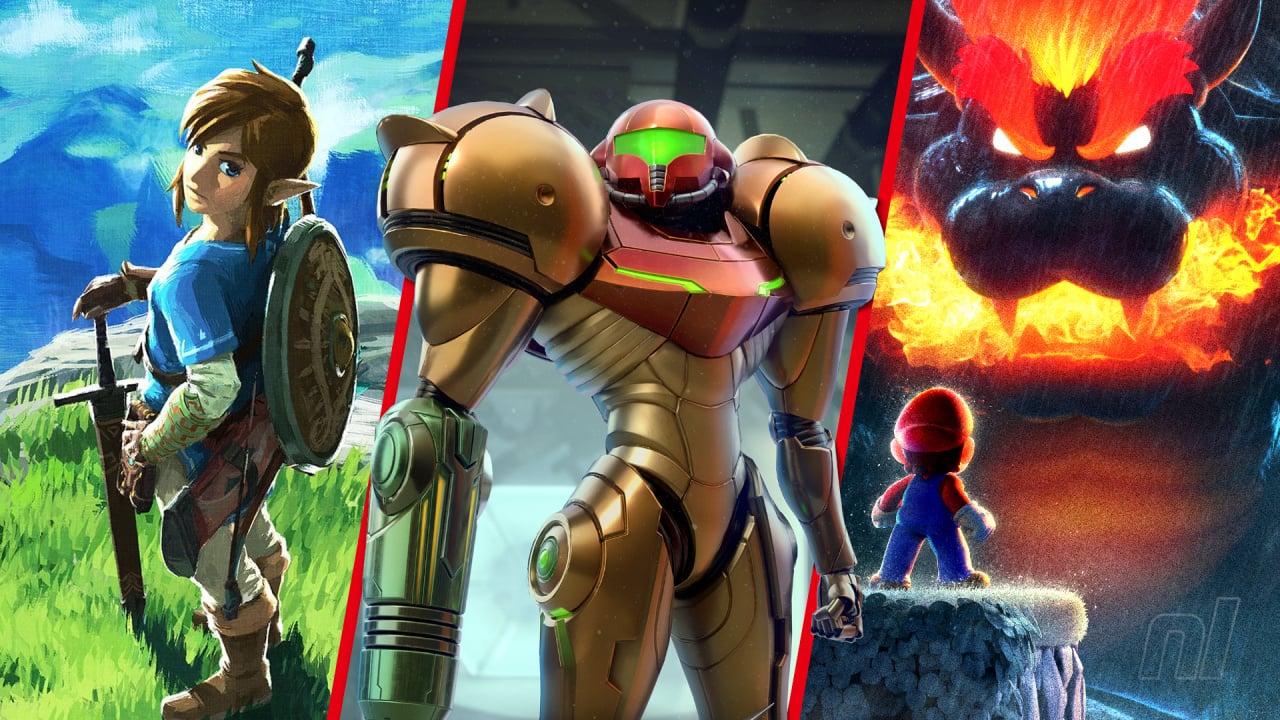
The Famicom launched in 1983. Time, huh? That's four whole decades of 8-bit Nintendo games, many of which defined entire genres and birthed enduring characters and series that would go forth and flourish in future console generations.
In honour of 40 years of quality from our video game purveyors of choice, we're publishing this list of the 100 Best Nintendo Games ever made. We're talking first-party published titles here, most of which Nintendo developed in-house, although you'll see some select second-party gems nestled in amongst all the gold from Kyoto's finest.
As with many of our ranked lists, this selection of the finest Nintendo games available to humanity is governed by each game's User Ratings on our database. Yes, this is a reader-ranked list, and a dynamic one that can change in real-time as individual game scores go up and down. As such, registered Nintendo Life users can click on the stars beside each game below and score them out of 10 and exert your influence on the ranking. If you've rated these games before, good on you! If not, it's never too late!
A couple of notes before we begin. We've excluded a handful of games to prevent repetition. The Wii U version of Breath of the Wild, for example, is incredible, but not enough to warrant having Breath of the Wild occupy two spots in the Top 10 (apologies for the spoiler there, but c'mon!). In cases where we've deemed the two entries to be too similar, we've kept the higher of the two (which, perhaps surprisingly, isn't always the HD or Deluxe Switch version). We've also removed all compilations in order to give more individual games a chance to shine. Complaints to the usual address.
Okay, that's enough prevarication. On with the countdown of the 100 Top Nintendo games of all time, starting with...
100. Pokémon FireRed and LeafGreen (GBA)
Pokémon FireRed and LeafGreen were Game Boy Advance remakes of the classic games that started it all, Pokémon Red & Blue. Yes, the Game Boy originals were known as Red and Green in Japan, because reasons.
Now available on Switch, did Pokémon really ever get better than this? That's up for debate, but vastly updated visuals, the ability to connect to various other Pokémon games to collect over 350 of the critters, and an enhanced user interface were just some of the upgrades offered in this 32-bit revamp.
For players intimately familiar with the Kanto games, this was the first opportunity (of many to come, of course) to indulge in some nostalgia and catch the original 151 all over again. Who could possibly resist? Watch out, Metapod. Or should we call you... Metapoo? Ah, the comedy! Happy days.
99. Professor Layton and the Unwound Future (DS)
The third entry of the mystery-solving DS Layton trilogy, Professor Layton and the Unwound Future doesn't stray too far from the winning formula of the first two releases, and instead focuses its attention on offering up what is easily the best storyline of the series on the console, not to mention some of the best minigames.
It's no slouch with the puzzles, either, and it's safe to say — fan of the franchise or not — this is a game you absolutely do not want to miss.
98. F-Zero X (N64)
Forum wars continue to wage over whether F-Zero X or its successor on GameCube is the superior white-knuckle futuristic racer. Both are essential, of course. The 64-bit entry is metal: pure, simple, guitar-screeching, all-out metal. EAD stripped back extraneous detail to achieve the smoothest, most blistering and nail-bitingly precise racing experience.
At this speed, on these dizzying tracks, even the tiniest prod on the spindly analogue stick matters, and the original N64 pad offers peak precision for micro-adjustments which make the difference between gracefully sweeping through a corner with nary a pixel to spare… or catching said corner and ricocheting between barriers to an explosive, humiliating retirement.
How much more metal could this get? None. None more metal. Flaming skulls and chromed motorcycles would actually reduce the metal content of this game.
97. Mario Kart Wii (Wii)
Following the online exploits of Mario Kart DS, it was almost a given that Mario Kart Wii would follow suit and include the ability to play against the world — thankfully, despite the console's rather anaemic online capabilities, the experience was nothing short of stunning.
From the outside, the Wii entry might have sacrificed some of the kart racing series' personality, but the online multiplayer with support for up to twelve players, optional motion controls (who could forget that plastic wheel accessory?), and additional vehicles and characters helped make it one of the most accessible entries in the series.
Successful, too. It sold a staggering 37.38 million copies.
96. Fire Emblem: Path of Radiance (GCN)
The first home console Fire Emblem to be released in the West — and only the third to be localised — GameCube's Path of Radiance introduced us to Ike, leader of the Greil Mercenaries and rocker of a blue barnet.
By modern standards, it's lacking somewhat when it comes to presentation, but this was the first in the series with fully 3D graphics and features (in our opinion) the strongest story of any entry. Ike would go on to join the fight in Super Smash Bros. Brawl and gain notoriety there before returning in the Wii sequel to this game, Radiant Dawn.
Unfortunately, this luminary pair of home-console Emblems aren't too easy to find physically these days, with both fetching eye-watering prices on the secondhand market. However, the ability to play Path of Radiance anew on Switch 2 without having to crack out the 'Cube and put a massive dent in your bank balance is a blessing. We like Ike.
95. Kirby and the Forgotten Land - Nintendo Switch 2 Edition + Star-Crossed World (Switch 2)
Kirby and the Forgotten Land - Nintendo Switch 2 Edition + Star-Crossed World (say that five times, etc.) gives you the base game at a delicious 60fps with a whole big bunch of new content thrown in for good measure.
If you've had your fill of Forgotten Land on Switch 1, there's nothing here to warrant replaying the entire game again, but the 12 remixed areas that make up the DLC are uniformly delightful, the new transformations are excellent, and there's even new challenges for hardcore Kirby fans to get stuck into.
One of the best games on Switch and one of our favourite 3D platformers in years, polished to a sparkly sheen and packing some meaningful new content? That's a very easy recommendation and a truly excellent addition to the Switch 2's early lineup.
94. The Legend of Zelda: Echoes of Wisdom (Switch)
With the titular princess taking a starring role in her namesake series for the first time, The Legend of Zelda: Echoes of Wisdom should be the new standard for top-down Zelda going forward.
Rather than abandoning the classic formula, Zelda has shown that the old and the new can come together and produce wonderful results that reward experimentation and reinforce the joy of play.
In our book, this is easily in contention with A Link to the Past and A Link Between Worlds as one of the best top-down adventures in the series, and we hope we don’t need to wait another 35 years for Zelda to take the lead again.
93. Golden Sun (GBA)
Golden Sun is a fine RPG, perfecting the classic formula whilst introducing unique mechanics of its own.
An intriguing setting, likeable characters, and gripping story are the bread-and-butter of any good RPG, and Camelot doesn't disappoint on those fronts.
The first few hours are a slog, but stick with it and you'll be rewarded with a rich, deep RPG that desperately deserves a modern-day instalment.
92. Donkey Kong (GB)
It's rare that the echo triumphs over the voice, but if we had to pick between playing arcade DK or the Game Boy port, there's really no choice.
Donkey Kong on Game Boy — Donkey Kong '94 as it's often called — is far more than just a simple sequel or port. After finishing the first four levels, you might assume that's it, but with over 101 levels in total, there's a whole other game awaiting you. In fact, it laid the groundwork for spin-off series Mario vs. Donkey Kong.
Adding a metric ton of new features while still managing to keep the ‘arcadey’ feel of the original, the visuals and music are outstanding and complement this impressively expanded take on an icon. It's up there with the Game Boy's finest, and another wonderful portable title featuring Mr. D. Kong.
91. Animal Crossing (GCN)
It's arguable that this series really came into its own in a portable context with the wonderful Animal Crossing: Wild World on Nintendo DS, but the N64 original nailed most of the systems first time out and this GameCube port of that Japan-only release introduced Animal Crossing's pleasant real-time village antics to the west.
It's a series that you play a little bit every day and that's much more easily accomplished on a handheld system which you can whip out on the bus or take on your lunch break. It's hard to return to a village tied to a home console these days, but then again it's hard to return to any previous entry once you've become accustomed to the myriad quality-of-life improvements of the next.
We'll always have the memories, though, and this first taste of village life was sweet.
90. F-Zero GX (GCN)
While debate forever rages as to whether the N64 entry or its Sega-developed GameCube sequel is better, we can all agree that both games are rather special in their own right.
F-Zero GX's story mode helps paint a picture of the 'F-universe' and those cutscenes featuring Captain Falcon and the gang sure add some pizzazz. The series also certainly never looked better than on GameCube.
The breakneck speed and brutal difficulty might put some people off, but racing doesn't get much purer than this, and seeing as this was the last full-blown retail entry from the franchise to come to a home console, this is still arguably the hottest take on F-Zero going. Track it down.
89. Wii Sports Resort (Wii)
Showcasing the chonky new MotionPlus accessory (eventually built into the updated Wii Remote Plus), Wii Sports Resort offered the kind of motion-tracking fidelity many of us had imagined the Wii would offer out of the gate.
Highlights of this game — which introduced Wuhu Island and expanded on the original game with a bunch of new activities — included fencing and throwing a frisbee for an adorable pooch.
88. Super Smash Bros. (N64)
Bearing in mind how carefully Nintendo began managing its characters and their image after the misfire of the (first) Super Mario Bros. movie in the early '90s, it's remarkable that the original Super Smash Bros. and its inter-franchise scrapping got off the drawing board at HAL Laboratory. Fortunately, Masahiro Sakurai's crossover brawler was permitted to exist.
At the time, the idea of a 'platform' fighting game without health bars was pretty revolutionary. Instead, as you beat up your opponent, they'd become more vulnerable to knockback from your attacks, with the aim being to knock them out of the arena entirely. Catering for up to four players with a simple control scheme (especially compared to other fighting games) and the addition of weapons and power-ups to spice things up, this first Smash was a rock-solid foundation for a series that would become one of the world's biggest fighting franchises.
The number of combatants and complexity of the N64 original may pale in comparison with later rosters, which plucked from the annals of video gaming history, but we still look back fondly on the very first time we had the opportunity to open a can of whoop-ass on Pikachu.
87. The Legend of Zelda: Skyward Sword (Wii)
Showcasing the sort of swordplay we'd hoped Twilight Princess would contain, The Legend of Zelda: Skyward Sword was a beautiful entry in the series which dared to try some new ideas, something the franchise desperately needed at the time.
It arguably didn't get everything right, and why Nintendo ditched the beautifully accurate IR pointer in favour of a gyro alternative which required constant re-centering — especially when everyone already had the IR sensor hooked up anyway! — is still a source of confusion for us. We found the MotionPlus swordplay itself excellent, though.
Chronologically, this is the very first game in the Zelda timeline, so it's pretty much required reading for series fans. While it has its naysayers, we look back on our time with Skyward Sword very fondly.
86. Mario Kart DS (DS)
Whether you can forgive its snaking ways or not, this was still a cracking entry in a series which arguably doesn't have a dud.
If you're unfamiliar, 'snaking' — a technique which involves using power slide boosts — did admittedly dampen the online experience back in the day if you hadn't mastered it, but online (sadly) isn't an option now. So if you're unhappy with how your local competitors are snaking, you can simply lean over and communicate your dissatisfaction in a direct manner. In the ribs, perhaps.
It should also be remembered that Mario Kart DS was the first in the series to offer online play – and that was a real game-changer in 2005. Of course, it's been surpassed since by its sequels, but having a fully 3D Mario Kart in your hands was a special feeling back in the day, and MKDS holds a special place in many a kart-lover's heart, including ours.
85. Golden Sun: The Lost Age (GBA)
Even though Golden Sun: The Lost Age plays much like any standard RPG, there is something special about it. Even with its lack of structure towards the beginning of the campaign, its accessible, engaging nature keeps you wanting to play and experiment.
The Lost Age is very much a 'Part Two' — a continuation of the first adventure — but builds, modestly, on almost everything from the original Golden Sun: a longer campaign, extended Djinn mechanics, greater challenge, clever puzzles, and minor graphical improvements.
Newcomers would do well to start with the first entry, as the game does take for granted that you know the basics, and the plotline will make little to no sense – at least initially. However, for those who've played and enjoyed the first instalment, this concluding chapter is a real no-brainer.
84. Pikmin 2 (GCN)
Removing the 30-day time limit that so irked players in the first game, Pikmin 2 expands on the original in every way, creating a larger adventure with more of everything you liked before, plus a host of extra modes (including a surprisingly addictive two-player component).
Wingman Louie joined Captain Olimar this time around and the game also introduced White and Purple Pikmin, expanding the puzzling possibilities and the options available to you as the diminutive spacemen and their plant-based charges ran around gardens fighting beasties and collecting tasty-looking fruit, discarded objects, and ship pieces.
Some players might miss the tight focus of the original, but this is an excellent sequel and absolutely worth digging up.
83. Pikmin 3 (Wii U)
Beautifully crafted and filled to the brim with exciting gameplay features, Pikmin 3 is a worthy instalment in Nintendo's quirky strategy series.
The core gameplay mechanics remain true to the GameCube originals, but were further enhanced by the unique features of the Wii U GamePad, although you could still use your Wii Remote and Nunchuk (honestly, the 'Deluxe' Switch port offers further proof that the GamePad really was a peripheral option here).
A few minor issues here and there arguably prevented it from reaching the heights of its predecessors, but the Wii U's HD sheen made the fruit hauled by your little plant-based helpers look more delicious than ever.
82. Eternal Darkness: Sanity's Requiem (GCN)
Eternal Darkness: Sanity's Requiem is a brilliant psychological horror game that blends Resident Evil-style survival horror with Lovecraftian Old World magick and an era-hopping historical narrative to create something quite unique and only available on GameCube.
It may take you a while to get into its spellcasting and unusual mix of styles (and that may be the reason second-hand copies cost mere pennies for so many years), but once it gets under your skin it's a hard game to shake.
The fourth wall-breaking sanity effects always steal the column inches, but the ambitious, dread-soaked story deserves just as much recognition, and whether you're a hardcore horror aficionado or a novice that needs a walkthrough with the lights on, we recommend playing this any which way you can.
About Gavin Lane

Gavin first wrote for Nintendo Life in 2018 before joining the site full-time the following year, rising through the ranks to become Editor. He can currently be found squashed beneath a Switch backlog the size of Normandy.
Related Articles

Nintendo To Change Pricing For Digital & Physical Switch 2 Exclusives, Starting With Yoshi
Update: Nintendo confirms "The cost of physical games is not going up"

Pokémon Pokopia: Cooking Guide - All Food Recipes, Flavours & Effects
Ditto used cook! It's super effective!

Multiple Switch Games Receive Switch 2 Compatibility Fixes
Kirby, Final Fantasy and more

Pokémon Pokopia: All Mosslax Food Buffs - What Does Eat Do?
Anything but lax

Pokémon Pokopia: Dream Island Guide - All Materials, Dolls & Islands
Dream a little dream
Comments 153
My Top 10 Nintendo games I have.
1. Animal Crossing New Horizons (Switch)
2. Yokai Watch 3 (3DS)
3. ARMS (Switch)
4. Animal Crossing Amiibo Festival (Wii U)
5. Wii Music (Wii)
6. Go Vacation (Switch)
7. 1-2-Switch (Switch)
8. Miitopia (3DS)
9. Tomodachi Life (3DS)
10. Wii Party (Wii)
The list has a disturbing lack of NES titles, in my opinion.
Justice for WarioWare: Smooth Moves...
One of my absolute favourite games of all time, and I'm slowly and painfully dying to play Move It.
As much as I love BotW... Tears of the Kingdom is better in every way. Should be first.
I understand why you didn’t, but I would have preferred grouping remakes as one entry (Wind Waker HD/GC), it would have left more room for unsung classics in the top 100.
@the_beaver
It’s too soon, give it a couple of years and it will top this kind of list.
This is nightmarishly difficult, but here’s my Top 10:
1. Link to the Past
2. Donkey Kong Country
3. Mario 64
4. Mario Kart 8 Deluxe
5. Metroid Dread
6. Ocarina of Time
7. Super Metroid
8. Luigi’s Mansion 3
9. Super PunchOut
10. Super Mario Maker 2
I may be getting on a bit, but I wouldn't trade it for anything. I am blessed to have been able to play through every evolution and innovation of Nintendo's games since day one.
Needs more Star Fox Guard!
Super Mario 64 not in the top 20? IMO newer games get extra credit due to younger crowd voting, as well as obviously being more recently on one’s mind (regardless of person’s age).
I can find myself in this list, though I haven't played some of these games. The majority I have though and most I feel definitely deserve a spot in this list.
Remember that a list voted by a diverse public in a spam of over 30 years is bound to have many distortions and just making to the top 100 should be celebrated.
That said, the top 20 is simply 👌👌
Well done everybody who participated
F-forty years?! o.o Oh dear, I suppose it has been now. I'm getting old. (I say that, and yet I'm not 40 yet lol)
Disappointed that Pokemon Black/White are so low! They are my top favorite Pokemon games. Also sad to see the Galaxies beating out the other 3D Marios - even Odyssey? Come on, people. =(
I'm gonna get flack for this, but Tears of the Kingdom is overrated. In a few years when the hype has died down, people will look back on it the way they do Skyward Sword and realize just how numerous its faults are. It definitely doesn't deserve a place over classics like Super Mario World and Super Mario Bros. 3, in my opinion.
@Harmonie I didn't really think Odyssey was all that great, either. Not bad by any means, but I was let down by the lack of platforming challenges and the overabundance of Power Moons that can get tedious to collect because you're jusy doing the same repetitive busy work like kicking glowing rocks or ground-pounding the glowing spot.
The comments are gonna tear me to shreds for these hot takes. 😬
@Anti-Matter Wait, what?
@Kasparius I agree, I hate the way they do these. Multiple versions of what's essentially the same game. Like Majoras Mask, just list the better version and mention the other in the blurb with it.
Very bizarre to see the black-and-white version of Link's Awakening, of all things, coming in at #4.
I'm happy Thousand-Year Door managed to crack the top 10, though. My faith in humanity has been restored.
I don't see Gameboy Donkey Kong 94 in that list therefore it's invalid.
There is no way Breath of the Wild being objectively rated higher than Tears of the Kingdom!!!!! I was in Love with BOTW but TOTK does everything so much better. Better World, so many sub bosses, more creativity with fusing anything together, better abilities, characters and a decent last boss fight, which was lame in BOTW. Also Depths, Sky as a bonus, finally some dungeons, so many great locations. Great weapon creations and a really good story! There is no way the first game could be rated higher in any regard!
Breath of the Wild....??!
:/
The heck I say. The heck!
@Qphlat27
Well, everybody have different interest in gaming.
My gaming choice is also different.
My favourite game of all time is No. 99. Awesome 🥲
It's pretty hard for me to have a concrete Top 10 Nintendo games of all time given how most of my life has been dedicated to Ninty but I'll give it a go regardless XD
10. Metroid Fusion
9. Punch Out
8. Super Mario Bros 3
7. Pokemon Super Mystery Dungeon
6. Pokemon Legends Arceus
5. Legend of Zelda: Link's Awakening
5. Kirby 64: The Crystal Shards
4. Splatoon 3
3. Kirby and the Forgotten Land
2. Super Mario Galaxy
1. Pokemon Black/White
Lots of Zelda at the top as to be expected. I haven't completed Tears of the Kingdom yet myself, but I've been enjoying it more than Breath of the Wild so far. That said, I understand that it's hard to top the sheer wonder of experiencing Breath of the Wild's open world for the first time.
Some other scrambled thoughts:
I'm glad to see Advance Wars getting lots of love. I'm not sure how well Reboot Camp sold, but I hope it's enough to reignite the franchise.
I still need to play Luigi's Mansion 3. It seems that everyone keeps gushing about how great it is.
I'm very happy to see A Link Between Worlds so high. It's incredible that Nintendo managed to knock it out of the park with a sequel to a beloved game more than 20 years after the fact.
Xenoblade Chronicles X really needs to be ported. It's different from all the other entries, and its sprawling world makes it my favorite. Plus, as an anime fan, I love Hiroyuki Sowano's score.
Pokémon Legends is definitely something that needs to continue, and I hope Arceus is a template for Gamefreak to freshen up Pokémon battles because they're so much more involved and fun than in other entries.
Super Mario World is still the pinnacle of 2D platforming to me, and I'm glad others feel the same. Some of those secret exits are so creative. Chocolate Island 2 with needing to enter the next area within a certain time is still so genius to me, and this game set the template for post-game levels.
My top 5 has been Xenoblade Chronicles, Skyward Sword, Pokemon Red, Mario Sunshine, and Kid Icarus: Uprising in roughly that order for a decade. Beyond that, it gets a bit too granular for me to bother working out. Sure hope something eventually comes along and mixes that list up.
@Not_Soos I’m with you on BotW and TotK. I don’t particularly like the formula. They’re undeniably very well made, and they feature some really great concepts, but they are near the bottom of my list of personal favorite Zelda games. My biggest want from Nintendo is a brand new top-down Zelda, but I’m probably very much in the minority.
1. Ocarina of Time - The feeling that game gave will never be matched.
2. Breath of the Wild
3. Super Mario Galaxy 2
4. Super Mario Sunshine
5. Banjo Kazooie
6. Goldeneye
7. Metroid Prime
8. Smash Bros Meelee
9. Pokemon Red/Blue
10. Super Monkey Ball 2
BotW is a much purer and simpler experience than TotK, which mixes up so many different characters, biomes and gameplay mechanics. For the BotW veteran this is enjoyable. But I’m certain that in ten, twenty years when people are asked, they will hold BotW in higher regards.
Super Mario World is still the best game Nintendo ever made.
Very surprised to see Metroid: Dread so high up the list.
Nothing against Zelda, but having it be 5 out of 6 of the top games is too much. Apparently Zelda fans are higher scorers than Mario fans 😝
Here are the only games I've ever rated 10/10 in no particular order. As you can see I have a bias:
Getting down to the rest of my top 10 would probably also include:
It's so hard to think over my whole life rather than just Switch games, so I'll stop there.
Edit: Feels bad that Triangle Strategy, a Square Enix game which isn't even exclusive to Nintendo hardware is on this list, but Super Mario Maker 2 didn't make it.
Removed - foreign languages
1. Breath of the Wild
2. Super Mario Odyssey
3. Metroid Dread
4. Tears of the Kingdom
5. Donkey Kong Country 2
6. Kirby’s Adventure
7. Super Mario Bros 3
8. Super Mario World
9. Super Mario 64
10. The Legend of Zelda: Ocarina of Time
I think this would be my top 10, but, man, is that hard to whittle it down. There’s so many 10/10 tier first party Nintendo titles. Even going to a top 25, we’d be seeing a list that averages a perfect 10/10. Starting with Donkey Kong, Nintendo has pretty much been the best developer on the planet…
All I can say is I’m glad thousand year door made it to no.8!
Nintendo where’s the remaster?!?!!
Seeing Pokemon HGSS on the list reminds me of how sad BDSP makes me.
The only remake to not include the national dex or the graphics of the current gen. I can't believe ORAS has a larger roster.
It could have been the definitive version of Gen 4. An even better Platinum!
The best Xenoblade games in the top 20 you love to see it!
This list is gonna be slightly different every time you ask me, but I feel pretty good about it this time:
10. TLOZ: A Link Between Worlds
9. Super Mario Odyssey
8. Animal Crossing New Leaf
7. Donkey Kong Country
6. Metroid Dread
5. Luigi's Mansion 3
4. Mario Kart 8 Deluxe
3. TLOZ: Breath of the Wild
2. DKC Tropical Freeze
1. Super Mario Bros 3
Thanks for all the great games Nintendo. Still planning on playing Xenoblade Chronicles 3 this year. Metroid Dread is a must too, and I want to love Tears Of The Kingdom.
It has been a while but Pikmin 4 will be a day one buy again.
You all should be ashamed of yourselves for putting Double Dash & Mario 64 that low on the list.
Tears of the Kingdom should be number 1, and, you broke your own rule, of putting multiple versions of a game. Wind Waker HD is way better than the GC version, you should have only put one of them on the list.
Breath of the Wild is Ocarina of Time but with all the most exciting and important parts spaced much further apart, using a a ton of lesser content like reward/combat shrines and korok seeds to fill those 100's of hours worth of padding
@Oh_Well Were any of the Punch-Out!! titles on the list?
Excitebots at 0 and Super Punch-Out!! at .5 and whatever, it's fine.
It’s a little weird to see Phoenix Wright and (especially) Ghost Trick missing considering that (until this console cycle) these were Nintendo Exclusives.
Also weird considering Symphonia made the list…
I understand Phoneix Wright not being everyone’s cup of tea… but ghost trick is pretty universally loved
@glaemay I believe it’s on the list!
I enjoyed it, but I’m a little surprised to see Metroid Dread so high. I agree with the people who think TotK is overrated. It’s just too much of everything and it seems like people anointed it the greatest game ever even before playing it. I enjoyed BotW much more.
@Kasparius They said they would do that in the intro with BOTW as an example, but then they have multiples of Ocarina of Time, Wind Waker, and Majora's Mask. I guess it's a remake vs. remaster vs. port distinction? I also think those should be once max.
Waaait, no Good Feel-developed Kirby or Yoshi games? Man, I’ve been on a binge of those lately and they are sooo good!
If I'm honest, TOTK is such an improvement on the original, BOTW seems a lots more empty than prior to the sequel's release. Yes, it revolutionised Zelda and the open-world genre, but the gameplay is just made to feel inferior by TOTK's brilliance.
(P.S. I've said it before and will say it again, Splatoon 2 being ahead of 3 is nothing short of criminal).
@Not_Soos the funny thing is that the general Skyward Sword reception got better with every year. So I don't see how Totk can get an even better reception.
@Thomystic
I think those remasters/remakes are great but they aren’t drastically different like say FF7R. I think most people who love the remakes love the original and Vice versa. Definitely should have been one entry for those.
My top 10, in no particular order,
Yoshi's Island
DKC2
Ocarina of TIme
Super Metroid
Mario Bros 3
Link's Awakening, (GBC)
Super Mario RPG
Eternal Darkness
Metroid Fusion
Tears of the Kingdom
@Kasparius I was going to post this too! Windwaker and Ocarina of Time each being in the top 20 twice is odd.
Good list. Happy to see Metroid represented so highly (up there with the top Marios and Zeldas). Thankfully it's led to better sales for more recent games like Dread and Prime 1 remastered. Hoping Prime 4 is a glass-ceiling buster game for the franchise like Breath of the Wild was for Zelda.
My biggest issue is Paper Mario 64 being as low as 50. Sacrilege I say!
@canaryfarmer Did you unironically not expect BotW to be at #1?
I'm a bit sad that Astral Chain isn't on the list.
Interesting list. And seems as others gave their top 10's I guess that gives me an excuse to give mine 👍
10. Xenoblade Chronicles 3D
9. Super Mario World
8. Fire Emblem Awakening
7. Super Smash Bros Ultimate
6. Mario Kart Double Dash
5. Xenoblade Chronicles 3
4. Splatoon 2
3. Ruby/Sapphire
2. BOTW
1. Fire Red/Lead Green
At the very least, Dread and Super should switch places. Other than that, I’m good with most of the top 20. Though I do like TotK more than BotW.
Wind Waker is overrated in my opinion. It's not even as good as the N64 Zelda games. Majora's Mask should be up there and no, the 3ds version is not the definitive version, it messes up too many important things from the original. I would put Tears of the Kingdom and Xenoblade 3 on top.
chrono trigger has to be on this list no matter what!!
Hard disagree on Xenoblade 3, it made me like Bayonetta 3's plot because I came in knowing what actual bad writing looked like. I still give it an 8 but that second half writing was embarrassing. I'd switch it with X, a port couldn't come any faster.
Love the Zelda games but gotta give a shout out to Spirit Tracks. Probably my favorite incarnation of Princess Zelda.
Sakurai's "Meteos" (DS) sweeps Tetris. Bravely Default also needs some mentions fr.
1. The Legend of Zelda: Tears of the Kingdom and Breath of the Wild
2. Xenoblade Chronicles: Definitive Edition, 2, 3
3. Super Mario 3D World + Bowser’s Fury
4. Super Smash Bros. Ultimate
5. Metroid Dread
6. Metroid Prime Remastered
7. Mario Kart 8 Deluxe
8. Animal Crossing: New Horizon
9. Splatoon 3
10. Kirby and The Forgotten Land
I am convinced if I were ever in a deserted island these 10 would suffice.
Why do people keep saying that Metroid Prime 2 is too difficult when Metroid Dread is the one kicking your butt 24/7? The only thing that’s difficult in MP2 is the boost ball boss and maybe traversing the dark world before you have the dark suit.
Most of them switch games shouldn't be in there👎🏽🤕
My top 10:
Fire Emblem: Three Houses
Link's Awakening (Switch remake)
Majora's Mask
Metroid Fusion
Snipperclips
Super Mario Bros. 3
Tetris (Game Boy)
Triangle Strategy
Xenoblade Chronicles
Yoshi's Island
@GrailUK Likewise, very few games on this list that I haven't played and even fewer that I don't own (yeah, I got a big backlog). Other companies wouldn't even be able to put together a top 50 of their published titles with a straight face and here we have Nintendo with a top 100 certified bangers, the lowest game on the list has a 8.56 user score here, 8.8 user score and 9.0 professional aggregate review score on Metacritic, for heaven's sake.
I don't care what anyone says, this company has the magic touch.
Where is Perfect Dark?
@Switch_Pro Back in the 80s and 90s, anything went. People got their inspiration from other places outside of gaming (because there often wasn't a game for point of reference.) To a much higher degree than anyone else in the industry, they have retained that artistic merit. It's easy to see other companies jumping on the 'we need this game on our system' bandwagon. Look at howthe lowest common denominator wants some sort of XBox Smash game with all the Activision characters. They must have been up all night thinking of that. Getting inspired by another game very rarely captures my imagination. Sequels often have a hard time too. Unless they don't replace the original in some way. And Nintendo are very good at that too.
Yeah, they just get it. And it's easy to see the industry tries their damndest to copy them...but for some reason, they just don't get them. "Nintendo will Nintendo" is tossed around like they don't know what they are doing, but whoever says that often betrays the fact how shallow they think gaming is (or how shallow it needs to be for them to be satisfied lol!)
Anyhoo...too late for a rant. I don't say Nintendo are the best because I'm a fan...I'm a fan because Nintendo are the best. (Ooo, I need to say that more often!)
My top 10 list would have:
Donkey Kong Country 2, Mario Odyssey, Metroid Prime, Metroid Prime 2, Metroid Fusion, Pokemon Red, Zelda Twilight Princess, Zelda Wind Waker, Zelda OoT3D, and Fire Emblem Awakening.
These would alternate order repeatedly
Strange to talk about frame rate and the such when evaluating a game from 1998. Every game should be held to it merits when it came out and how you felt and thought at that time. Especially games in series. They stand on the shoulders of what came before them. Exploring in Ocarina of Time was far more exciting in its time than the admittingly brilliant vastness of Breath of the wild in 2017.
Donkey Kong tropical Freeze is criminally low and should be in the top 5, same with pokemon platinum. Those are absolute masterpieces. Xenoblade Chronicles 3 over 1? Nah!
I would say numero uno should be Ocarina of time which may sound cliché but it really is something else
It's a good list overall. I would cut out some of these remasters/remakes and consider them part of the same game and give pros and cons for the remakes (though I guess if the story or gameplay is massively overhauled it's not really the same title, say for Heart Gold & Soul Silver or for Zero Mission). But surely Ocarina of Time 3D or Wind Waker HD could be merged into the same game slot?
In any case, this is a great list, regardless of quibbles about what comes before what. Play any of these games and you'll almost certainly find something to love.
a link to the User Ratings database would be good.
If TotK had proper OoT style dungeons then it would be my #1.
1. Super Mario 64
2. Ocarina of Time
3. Metroid Prime 2: Echoes
4. Xenoblade Chronicles
5. Sonic Adventure 2
6. Tears of the Kingdom
7. Pokemon ORAS
8. Hollow Knight
9. DKC: Tropical Freeze
10. Portal 2
Resident Evil 4 clearly. The original obviously.
Apart from that have I gone insane or was there no Wave Race 64 here? If that's the case I am not insane it is everyone else who is insane. Best water based racing game of all time. Nothing has come close including its sequel.
My top 10 Nintendo published games, in order of release:
Donkey Kong Country 2
Starfox 64
Majora's Mask
Pikmin
F-Zero GX
Metroid Prime 2:Echoes
Donkey Kong Jungle Beat
Mario Galaxy 2
Pikmin 3
Tears of the Kingdom
What a surprisingly solid list. A few oddballs, but generally very coherent of an aggregate.
My Top 10:
10. Mario Party Superstars (Switch - 2021)
9. Metroid Prime Trilogy (Wii - 2009)
8. Pokémon Black (DS - 2011)
7. The Legend of Zelda: Ocarina of Time 3D (3DS - 2011)
6. Splatoon 3 (Switch - 2022)
5. Super Mario Galaxy (Wii - 2007)
4. Super Mario 3D World + Bowser’s Fury (Switch - 2021)
3. Super Smash Bros. Ultimate (Switch - 2018)
2. Donkey Kong Country Returns (Wii/3DS - 2011/2013)
1. Kid Icarus: Uprising (3DS - 2012)
Make this a bulleted list instead of a ranked one, and you've got a list of 100 of the finest creations the world has made in the past 40 years.
@glaemay Number 55
Errr… so you explain that you’re only counting one version of each game, only to include Ocarina, Wind Waker and Majora’s Mask twice? Why? The ports are super similar to the originals. You could make a case for Link’s Awakening, maaaaybe.
Ugh. At least put the Switch version of Link's Awakening. Nobody is having fun playing the GB version in 2023.
Not a bad list overall. But Zelda remakes like Link's Awakening Switch, OoT 3D and WW HD should really be higher than the originals imo.
what has happened to Professor Layton World of Steam by the way?
@Znake
I get you, but I understand why BotW ranks higher for some: The atmosphere isn't just there for me in the same way. In BotW there was a sense of wonder that lacks from TotK for me. Surely TotK has way more things to do, but to me at least that's not always a postive. E.g. I don't really care for the building mechanics and just find them detracting from me experiencing the nature and locations, or you could say experiencing the breath of the wild
Also, I prefer finding a magical sword over constructing my own from pieces. Call me old-fashioned, but Fuse and such don't do much for me even if I can appreciate the mechanics on a rational level. Also, I really dug the guardians and so far haven't felt the same tension or coolness from any sentries or semi-common enemies.
Last, and I feel like I'm quite alone in this, I liked the understated story in BotW and loved finding those memories. In TotK I feel like the memories have been painted out like bullseyes across the map, ruining the magic of discovery for me ✨
Still, a mighty good game
This list is a travesty that completely undermines my fragile opinion of what games I personally enjoy most..... (sarcasm)
It's just a list folks, a data point, a curiosity. It is kind of like arguing over what the best flavor of ice cream is, when everyone knows it's Pistachio
BTW If the list were mine, there wouldn't be a single JRPG. (grenade thrown, and runs away)
No super Mario maker for Wii U? The sequel is good but the first is def a top 100 game.
My list
1. Metroid Fusion
2. Yoshi's Island
3. Bayonetta 2
4. Hades
5. Smash Ult (Switch)
6 Metoid Dread Demo
@GavinLane
It would be great if you could also take out the other Wii U duplicates like you did with Breath of Wild.
@NintendoWife
I agree, they should leave the highest scoring of the duplicates and take the others out.
With the inclusion of HGSS, I think Pokemon Crystal could be taken out too
My Top 10:
Link's Awakening
Super Mario Bros. 3
Kirby's Dream Land 2
Yoshi's Island
Paper Mario
Conker's Bad Fur Day
Donkey Kong Country 2
Advance Wars
Kid Icarus Uprising
Galaxy 2
I kinda understand the lack of Castlevania, Megaman, dragonquest and other multiplatformer like Crash gba and Sonic on this list but, no mario party, Mario Maker or any of the yarn games?
Get rid of the duplicate games, they're a waste of space.
Also is baffling seeing Arceus (a game that died quickly) on this list. Love the new Metroid, but is way to high.
@jamesthemagi exactly. Tons of spots wasted on duplicates.
@glaemay ikr, yet there's a few Zelda dups on the list.
Removed - disrespecting others
Wow. What a great article, by the way. Very useful to have a list of the very best Nintendo games.
@HeftyLaces
I am 38 years old dude.
I have different gaming interest.
Is that wrong to have interest with my Top 10 Nintendo games ?
Crazy that this list has already changed from when I first looked at it a couple hours ago
The severe (and I do mean severe) lack of NES representation on here is both shocking and disappointing but given the nature of lists like this, I really can't say I'm shocked either. Still it is sad to see so many great franchises not have any sort of representation on here from Mega Man, Castlevania, Chrono Trigger and more. In fact seeing the large amount of DS and Switch games shows how a list (and more specifically the voters) were skewed. I honestly can't say I agree with this list, but at the same time I recognize it for what it is.
My top 5 (very casual gamer and lists are very subjective and for some reason people get offended by them but here goes anyway)
1) BotW
2) Astral Chain
3) Metroid Dread
4) Metroid Prime Remastered
5) Tears of the Kingdom
There are many here that would never make my own top 100, but it's still interesting to see what titles resonated with others
1. smw
2. mk64
3. mk8dx
4. smb1
5. dkc2
Why does the internet have so many people who comment after only skimming? People are talking about Chrono Trigger and Mega Man in here! I kinda understand bringing up Mega Man since it doesn't require knowing how to read, but Chrono Trigger requires literacy!
@Scposteel It's a first and second party list. So that's why there's no Mega Man, Dragon Quest, Chrono Trigger, etc.
@LXP8
Close! But you forgot an important detail about Ocarina of Time: It's fun. It has thought-provoking dungeons, items you collect throughout the game to make it always feel new, a story, likable characters, and oh yeah! MUSIC. Even if you take out the hours of tedious padding, Breath of the Wild still would be nowhere near the quality of a real Zelda game.
I love to see the pikmin and xenoblade rep. Though putting wind waker HD and GC in the list was kinda odd. Still though I lot I can agree with and a good reminder of the Game cube games I need to play, that horror one looks cool
Removed - disrespecting others
Seeing them all laid out like this, it's hard to imagine any other game company ever coming close to matching the mighty N in terms of sheer volume of quality releases. This as an extraordinary catalogue of classics that reminds us all why we fell in love with Ninty in the first place.
1 - Ocarina of Time
2 - BOTW /TOTK - tied
4 - Galaxy 1&2 - tied
6- Yoshi's Island
7 - Super Mario World
8 - Super Mario Odyssey
9 - Metroid Prime Remastered
10 - Windwaker HD
@Anti-Matter nothing wrong with you list at all mate, don't listen to the haters, you can like whatever you like.
Aside from the superfluous entries of the original and HD remasters (why do we need 2 lots of Wind Waker in the top 20?), this is good list
Majora's mask N64 in the 22 place. Pretty good place. Tears of the kingdom in the third place.
@Scposteel
It is only Nintendo games, so Chrono Trigger, for example, does not qualify.
"We've excluded a handful of games to prevent repetition." I see Super Mario 3D World, Ocarina of Time, Wind Waker, and Majora's Mask twice in the list. You should've just counted these games once and include more NES games.
If nothing else, this list tells me I need to get stuck into to my backlog. I've only played about 16 or 17 of these, but have about 40-45 either in the backlog, or on the wish list.
The rest (Zelda, Pikmin, Fire Emblem etc) is stuff I'm not likely to play/not interested in.
I would have put Crystal Version ahead of Gold and Silver because of how much more depth Crystal has. Day and nite cycles were so cool as a kid, seasonal Pokémon, mystery gifts, new Pokémon types. First game I put several hundred hours into as a kid.. ah memories
@garzuit exactly.
Xenoblade series is the most overrated bloated mess of gameplay that has EVER existed in gaming history.
I've bought into the hype and tried THREE of these games now... never again, I can't stand them. Monolith Soft would much better moving on to some lost Nintendo IP's, more like a Retro that actually makes games.
Why is this list still influenced by fan reviews? This will only invite tons of spam accounts 🤦♂️
Nice list. I missed out on a lot of good games when I was a kid mostly because I wasn't into them at the time and couldn't afford them so my list are mostly newer titles. Here's my personal faves:
10. Fire Emblem: Three Houses
9. Splatoon 3
8. Mario Galaxy
7. Metroid Dread
6. Smash Ultimate
5. Breath of the Wild
4. Legends Arceus
3. Mario Odyssey
2. Pikmin 3
1. Tears of the Kingdom
@NinjaNicky
I'm guessing a lot of people like me haven't finished it so haven't rated it yet. It will be getting a 10 here unless the end pisses me off somehow.
The list will shift dynamically so it might change.
@Scposteel
My personal take on that would be that the majority of people like me come to NES games late out of curiosity and to educate themselves.
I don't think many people are then going to find that they would rate these experiences as 9 or 10s given all the advancements the medium has made. I think beyond Mario, only Punch Out and Kirby have really clicked with me.
Bias is probably also exacerbated by this being a UK site where the NES was never that big.
@ALinkttPresent I mean yeah, I agree with all your points, but I think they're a given at this point. I just wanted to say how Breath of the Wild is too padded out with lesser content compared to Ocarina
Honestly I just don’t get why link to the past is so highly rated. It’s dated and most of the concepts have been done better in later 2D Zelda games.
We done good here NLifers. Shame about the dupes.
My top 5 Nintendo Published games that didn't make the cut (at time of reading) :
Kid Icarus Uprising ❤️,
Conker`s Bad Fur Day (the seminal multiplayer game for the n64 amongst my friends),
Skyward Sword (albeit the weakest 3d Zelda)
Fire Emblem Shadows of Valentia,
Metroid Prime 3
@glaemay it’s there.
1. Super Mario Galaxy
2. Tears of the Kingdom
3. Super Mario Odyssey
4. Breath of the Wild
5. Luigi's Mansion 3
6. Pokemon Platinum
7. Bowser's fury
8. Partners in Time
9. Wii Sports Resort (I wanna move to Wuhu Island)
10. Mario Kart DS
Honorable mentions:
Windwaker, Kirby and the Forgotten land, Link's Awakening, Link Between Worlds, Mario Sunshine, Mario Galaxy 2, Wii Sports, New Super Mario Bros (DS), Mario Kart Wii, Legends Arceus, oh god i'm forgetting so many im sure
@Ultimapunch I am, lol. The GBC version is the best
@Corvus96 You got the rosiest tinted glasses ever my dude.
@Ultimapunch not at all. I just love 2d Handheld games, including ones I've played for the first time recently. It's possible I prefer the visuals, music, aesthetics, etc. Of 2D games like that in general because of nostalgia though I suppose
Kinda seems like there's a bit of bias towards newer games. Probably because of a lot of younger players these days, and because most people aren't reviewing old games still. Maybe I'm wrong though.
Since everybody else is doing it, here's my top 10 in no particular order:
Super Metroid
Super Smash Bros Melee
Pikmin 2
Animal Crossing - New Leaf
Super Mario 64
Zelda - BOTW
Pokemon FireRed/LeafGreen
Zelda - Links Awakening (GBC)
Metroid Fusion
Super Mario World
Mario RPG in 35th, Thousand Year Door in 10th and no trace of origami king. Good.
Hmm, my top 10 Nintendo games? Assuming we are talking Nintendo published games only, no third parties (otherwise there would be many Konami, Capcom and Shantae games padding out the list)...
1) Super Mario 64
2) Donkey Kong '94
3) Captain Toad Treasure Tracker
4) Animal Crossing New Horizons
5) Super Mario Bros 3
6) Links Awakening (or DX, or remake)
7) Donkey Kong Country (1+2)
8) Kirby's Adventure
9) Cruisin' Blast (Switch version)
10) Yoshi's Wooly World (port it to Switch please!)
Honourable mentions that could have easily been in the top 10 but I find it harder to place in a definitve order: Super Mario World, Wave Race 64, Pokemon Stadium (+Pokemon Blue!), Mario Kart 8 (maybe not deluxe) & MK64, Metroid Fusion, Luigi's Mansion, Star Fox / Star Fox 64, Super Mario RPG, Pokemon Heart Gold / Soul Silver, Paper Mario Thousand Year Door, Super Mario Land 1/2/3
@Corvus96 @Ultimapunch For me, the visuals of the remake are very nice looking, but its mostly the extra buttons that make the remake the "best" way to play - however I really don't like the fact you can't use the D-Pad, and every time it slows down or the framerate stutters, it annoys me. I hope that whatever the successor to the Switch is, is backwards compatible and willl run it at a smooth framerate, it really is quite jarring - and the fact they still haven't patched in D-pad support for a game that uses 4 way movement is very frustrating.
I honestly can see why some people would prefer the DX version, even without nostalgia for it. The pixel art is cute and it runs perfectly.
I love Links Awakening, its my favourite Zelda for the story, the design, and the weird quirkiness. But for me, there is no "perfect" version of it. Its the fact you don't have to keep swapping your buttons around for different items that makes me slightly prefer the remake. But as it stands, with the rough performance, its far from conclusively better.
I strongly believe games like ootHD and oot should be in the same ranking. that is the one reason i made an account, to post this
ALSO I THINK THAT EVERY SUPER MARIO BROS GAME AFTER SUPER MARIO BROS 3 IS JUST A HD REMAKE OF THE PREVIOUS
1. Super Metroid
2. TotK
3. Metroid Dread (it's every bit as good as Super, I will die on that hill)
4. BotW
5. Metroid Prime Remastered
6. Metroid Fusion
7. AM2R ()
8. Metroid Zero Mission
9. Starfox 64
10. Mario Kart 8
Shush, I have a type...
@Ayuawake This is a list of Nintendo-publushed games, those are Capcom games, both published and developed.
@johnedwin That's not a Nintendo-published game.
@molkom really good points! I agree that both games are great and I agree that some things are unnecessary. I liked the beasts too, but in TOTK each culture just had its own story overall, not just capture the beast. Crafting weapons I think makes things easier but both approaches are ok. But the ultra hand, the vertical teleportation, and recall are better to me at least. Then the smooth transition if you skydive or go directly to the depths. Also I loved in TOTK that each part of the world has different purpose- like Sky- ancient culture, depths super powerful beasts, some hidden temples, great rare resources and armor, you can fight old bosses too or defeated heroes. TOTK also has better temples, much bigger enemy diversity, and I like the utilization of the Sage skills more even if it can get funky time to time. The story in TOTK is amazing and much much deeper and sad too compared to BOTW which had minimal story but I agree that that atmosphere was maybe better. Just TOTK is very deep lore wise- how a super advanced civilization which disappeared thousands of years ago became like gods to the current civilization- great and deep analogy to poverty and religion today-Many great themes. And Minerva robot is great too. Plus all Kogha fights focus on developing mechs and the Yiga clan story is cool how they were the first to discover the depths. I could go on and on. One of my favourite games on ps2 was Dark Chronicle and here you fuse weapons, build your own house and can modify your own robot- far better than the bike in BOTW which was a misfit in my opinion. Also the options with fusing items with your shield-enemies bounce off, can create a skateboard, fuse shields with great swords, even fuse weapons with items… so many options. Plus many awesome mini quests- the sign posts, Korok transportation and more. And so many boss fights totall!!! In BOTW- just 4 beasts, desert mini boss, Kogha and Calamity Ganon. In TOTK you get 6 main bosses, and so many extra sub bosses- Frox, Gleeok elemental, Gleeok King, Battle Talus, Armored enemies and Lynels, Constructs, Gloom spawn and Phantom Ganon- amazing reference to Ocarina of Time! And most importantly Solid last boss fight-which was just so so in BOTW. Both are phenomenal games for sure, but I was speechless how much better TOTK is at least to me, and I love the franchise. I think it beats even Ocarina of Time for me. In the future I will definitely replay both again and I think it’s a good thing that both games are slightly different so it’s worth replaying them. But TOTK is better in so many ways that it’s crazy they managed to pull this off after already amazing first game. This game I call a masterpiece and nothing grabbed my attention as much- even the top games on my PlayStation. Super happy, this game was a blast. Just hope they add a master mode to make it even harder.
@dartmonkey, Wind Waker, Ocarina of Time, and Super Mario 3D World are on this list twice, though the intro says that games released on multiples systems would only be listed once.
Ah, SM3DW sneaked in at the bottom. I've removed it now, thanks.
With the others, we judged them to be sufficiently different from the originals to warrant inclusion, so they're in there.
It's very hard, I'm missing a lot of BRILLIANT games, but let's go with my Nintendo top 10 games:
1 - Zelda: Tears of the Kingdom
2 - Metroid Prime
3 - Zelda: A Link to the Past
4 - Zelda: Breath of the Wild
5 - Super Mario Galaxy
6 - Zelda: The Wind Waker
7 - Paper Mario: The thousand Year Door
8 - Metroid Dread
9 - Super Smash Bros Ultimate
10 - Mario 3D World
@Ultimapunch I just bought an OG Gameboy to do exactly that. I am old though so the nostalgia factor is real.
@dartmonkey
Hi, I compiled a list of all the duplicates below:
14 The Legend of Zelda: The Wind Waker HD Wii U
19 The Legend of Zelda: Ocarina of Time 3DS
38 The Legend of Zelda: Majora's Mask 3DS
87 Pokemon Crystal
91 Tetris DS
I will never understand how people still enjoy SMB3. Yes, it gave us world maps, sufficient mid bosses, secret exits, and toad houses, but everything else? Levels are too short, and their design is mid or confusing at best and kaizo at worst. The raccoon leaf is the only good new powerup: the p leaf and tanooki leaf are cheap knockoffs (with the tanookis extra ability being near useless), the goomba shoe barely does anything in the one level it's in, the hammer suit has an awful arch and is outclassed by the fire flower everywhere outside of castles, and the frog suit is straight up the worst powerup in the series.
The Koopalings are so lame to fight in this game, and Bowser is even lamer. The mini games are straight luck based. Yes, I'm aware of the warp whistles, but the way you find them is way too cryptic, and they're basically cooler looking secret exits. Add all that to the fact that the original game shows it's age with breaks in the music (which isn't good) every time you jump and can't load the front half of the screen in time. Finally, it's just too long. Literally the only thing going for the game is the feel of the controls, and even that doesn't feel satisfying to me.
Also, while I realize that the NSMB games are generally uncreative, I feel like the first one should have cracked the list. It brought back 2d Mario after over a decade. It introduced the wall jump, ground pound, and triple jump to the 2d plane. It had, IMO, one of the best sets of powerups in the series: the blue shell was super fun and proved to be a nice way to challenge yourself, the mega mushroom was even more fun and rewarding and could easily be accessed with mega mushroom houses, and the mini mushroom was a fun way to challenge yourself (it was even used to access two of the worlds). It had interesting and unique bosses. It had intricate level design. It had chirpy music. It even had tons of side content with the return of 64DSs 4 player battles and mini game collection, this time with more fun mini games, as well as the Mario versus Luigi mode that was so much fun. Honestly, NSMB1 doesn't get the respect it deserves.
With that said, here is my top 15
15. ARMS
14. Kirby's Adventure
13. Kirby Fighters 2
12. Super Smash Bros. Ultimate
11. Splatoon 2
10. Super Mario World
9. Super Mario Odyssey
8. Paper Mario 64
7. New Super Mario Bros. (DS)
6. Splatoon 3
5. Mariokart 8 Deluxe
4. Super Mario Bros. Wonder
3. Super Mario 3D World + Bowser's Fury
2. The Legend of Zelda: Link's Awakening (2019)
1. Super Mario Galaxy
I am trying to expand my interests (planning on getting SSHD for Christmas), but regardless of what comes, Super Mario Galaxy remains my #1.
@jamesthemagi the only remakes that deserve to be on this list are both Links Awakening remakes and the ones for Mariokart 8 and Super Mario 3d World. Everything else is redundant.
Also, shout out to Skyward Sword, Mariokart 7, Metroid Prime 3, Spirit Tracks, and Punch Out Wii--all of which should have been here.
@Ninfan they absolutely should be on there, and that's not just recency bias. Nintendo has proven themselves capable of making high quality games on their latest console, with greats like Odyssey, 3DW+BF, LM3, Links Awakening (2019), Dread, Prime Remastered, SMB Wonder, Three Houses, SSBU, ACNH, Super Mario RPG (2023), Splatoon 2 and 3, Pikmin 4, I could go on. BOTW and TOTK are probably higher than they should be (the best is a toss up between LTTP and OOT), but these games plus the actual rereleases give the Switch the best library of any video game console ever.
Also I find it funny that New Super Mario Bros. Wii and Mariokart Wii are nowhere on this list considering the massive followings those games have (of which I am most definitely not part of).
@idkHD that's not true and you know it
No Mother 3? I think I am gonna vomit.
@Scposteel I do see one too many DS and Switch games, but seeing how those two (well, the 3DS, technically) are my favorite consoles, I can't say I'm sad. I will say, though:
However, I'm not sad at all about the extreme lack of NES, because the only NES game I genuinely love is Kirbys Adventure.
Why are DKC2, Super Mario 64, Yoshi's Island OG, and plenty of others so low?!!!
Holy cow, how this list has changed in two years. It needs a republish.
BotW should be over TotK imo because it did the open world first.
If Super Mario RPG made the list (famously made by Square it’s absolutely criminal that Chrono Trigger is omitted).
Wave Race:Blue Storm not on the list? Did what Wave Race did but SO much better.
Is it me or did Super Mario Sunshine not even make the list? Definitely my favourite Mario Game followed by Wind Waker.
Conkers Bad Fur Day not making the list if only for being the most adult and funniest, clever game Rare made for any console. That Nintendo even greenlit it let alone published it at the time is a miracle.
The SNES, N64 and GC were my favourite Nintendo years although I LOVE the Switch/2. I realised how old I was when Resident Evil celebrated its 30th birthday recently and I realised I was 30 when I played the original
I totally agree with the top two. Ocarina was my number one game of all time until 2017 when I first started playing breath of the wild then that became my number one ocarina is now my number two.
Show Comments
Leave A Comment
Hold on there, you need to login to post a comment...