
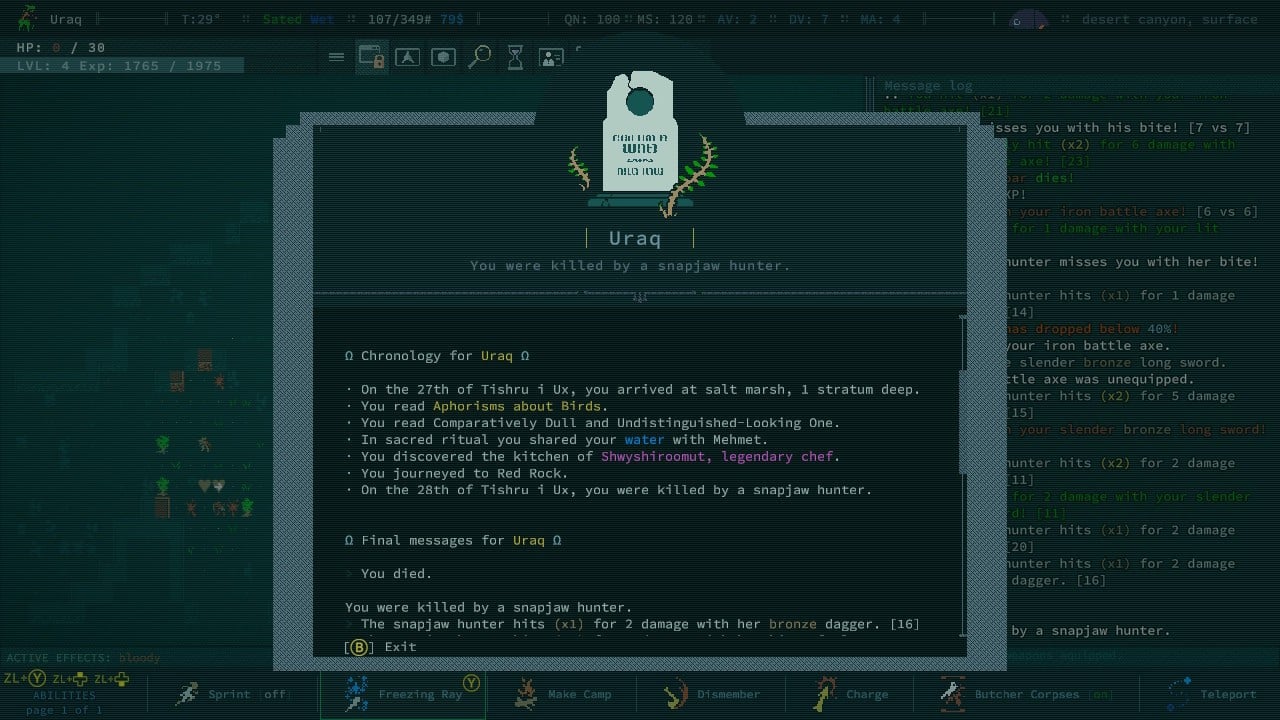
The legends of Caves of Qud stretch back into the ancient times, through mists of lore, to a moment of destiny. That’s right – all the way back to 2007, when American team Freehold Games began development on this ambitious roguelike RPG. After a 17-year journey to version 1.0 in 2024, gathering a devoted PC following, this intimidating, systems-heavy cult classic has rolled a new character on Switch.
The game is set in the post-apocalyptic, science-fantasy land of Qud. It’s populated by factions with either allegiances or animosities, ridden with organisms that either tolerate or seek to devour you, and driven by either rich spirituality or advanced technology. The either/ors are key, because whenever you start a run in Qud, it recalculates the decisions that set the whole scenario going. Your quest, as a new adventurer, is simply to get out there and survive in an exceptionally vivid open world.
Before setting out, you must choose between two genotypes: mutated humans and true kin. Mutants possess biological traits like a beak or slime glands, while true kin are humans enhanced by cybernetics like night vision or dermal insulation. Mutants are more fleshy and vulnerable at first, with a latent power ready to explode outwards as they level up; the true kin start tough and precise from the early game, but feel more and more dependent on technology as the levels climb. The two options are distinctive and fun.
At this point, though, we need a reality check. “Yes,” you say, “I’ve read that there are three-armed mutants and winged cyborgs and a stunning open world – but I’ve also seen the screenshots! Aren’t we getting a little carried away?”
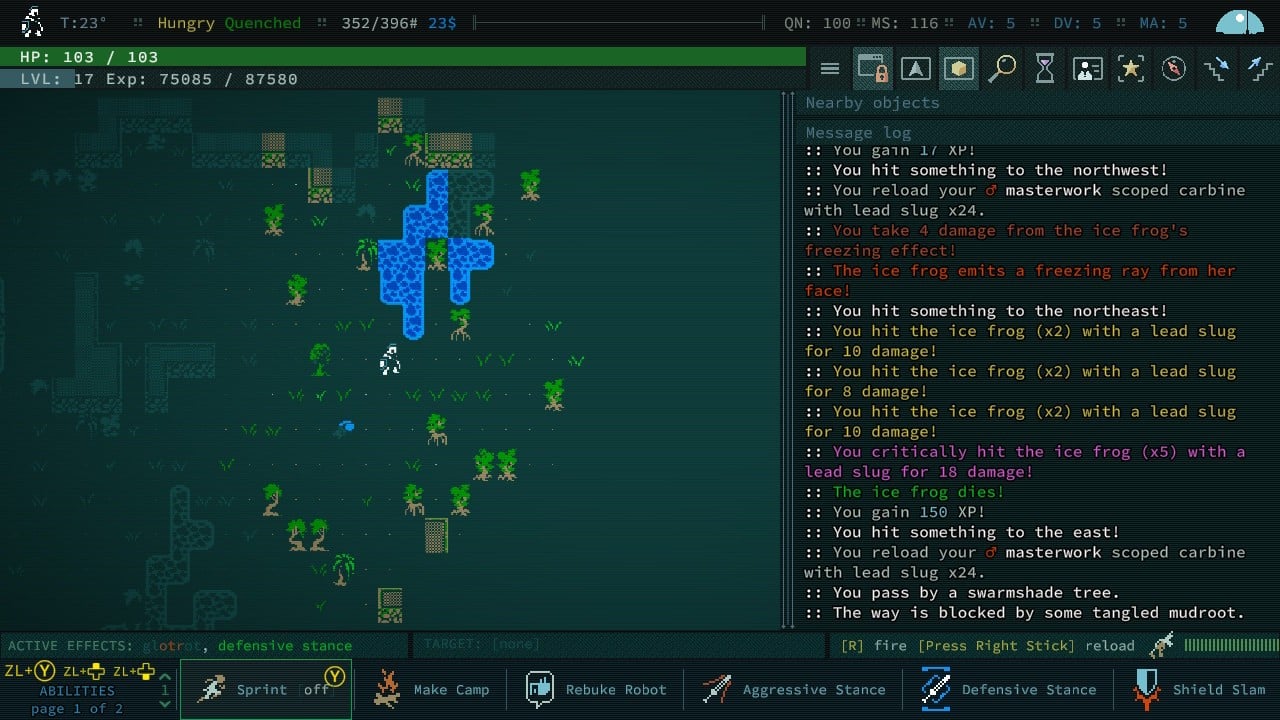
It’s true that this harks back to an era of astonishingly over-imaginative cover art and flickery ASCII graphics, but the effort to see the wonder in Caves of Qud is only needed for a few minutes. Barely has its stingy tutorial dropped you in at the (very) deep end when the efficient visual style and humour-lined, Hugo-Award-winning scenario reach out and grip you. The pixelated rectangular tiles that sometimes look like they could be ASCII writhe into life as robots and mysterious creatures. The sweeping music and ambient soundscape rouse into epic scores with triumphant melodies and the bustle of thriving towns.
And once you’ve leapt into the world of Qud, what happens? Well, anything, really. You’re free to play as you like, just aiming to survive and become part of its procedurally generated history.
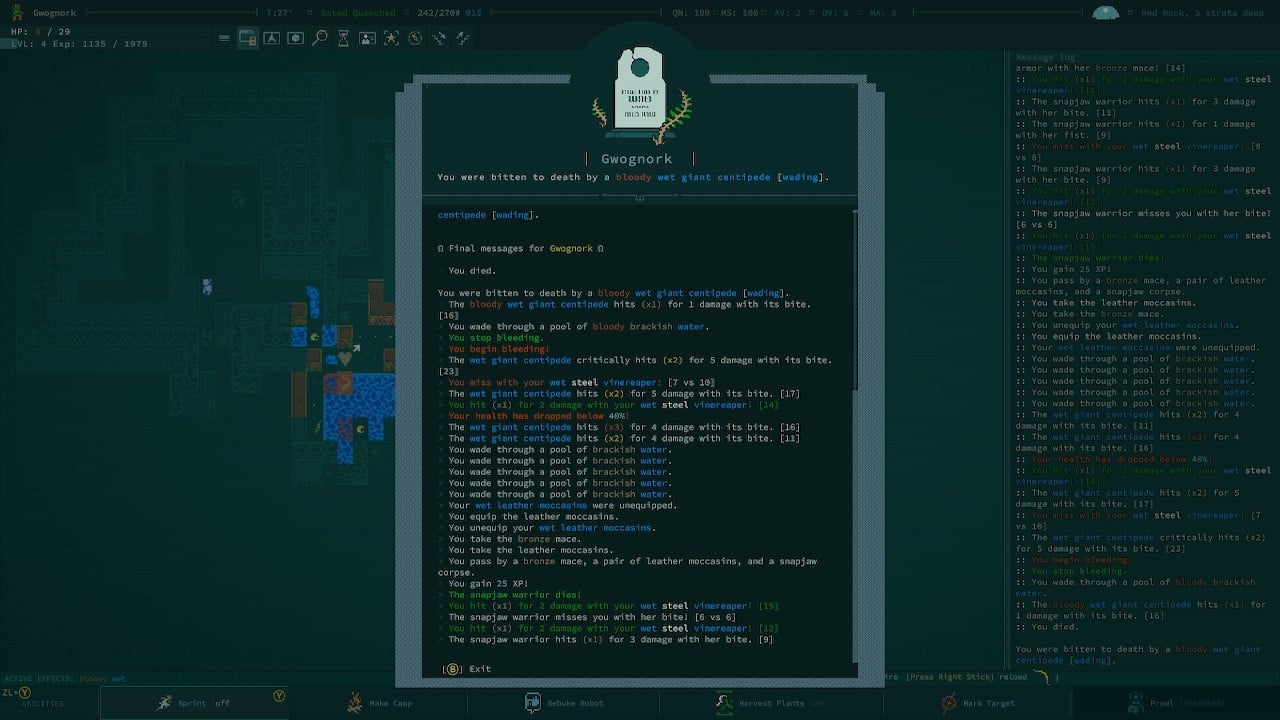
You won’t survive, though. My first achievement was collected by dying. It’s simply called “Welcome to Qud”. And this being a true roguelike, when you see “You died”, that’s your lot. No save points; no meta-progression: back to square one. It’s sad when your level-10 mutant croaks it after several hours’ play, but it’s also just part of their story. Qud is about making stories, and in that regard, it’s excellent.
However, there’s more to Caves of Qud than just regenerated lore and maps. A human spine of authored content runs through the cybernetic flavour text from the algorithms.
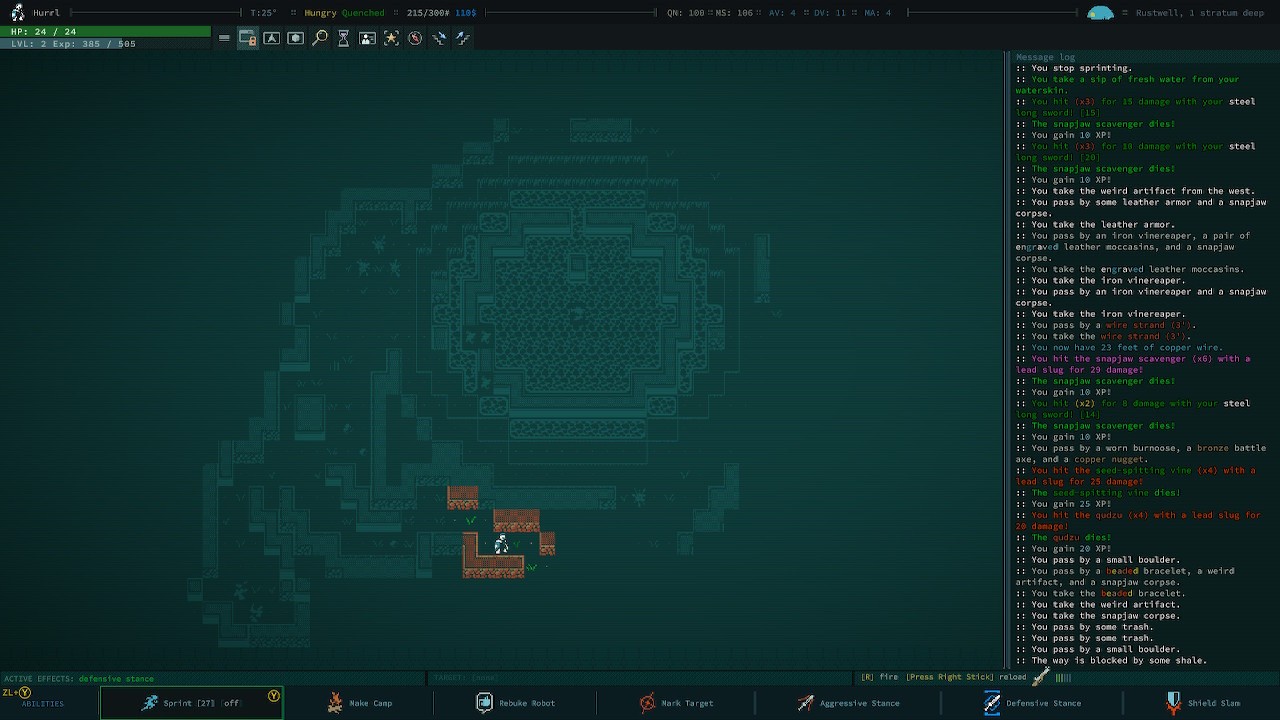
Firstly, the basic topography of the world map is unchanging. This gives the sense of new progress made each time you restart – it’s the same world, so how long can this character live in it?
Secondly, there is a quest line that’s completely authored. This epic takes you through caves, markets, and townships, hunting artefacts and running rescue missions for droids.
Or does it? Given how much danger is out there in Qud, trying to follow a plot amidst it all is hard work. It’s one thing to lose a dozen hours’ playtime when it’s a throwaway run of survive-until-you-don’t. It’s another to say goodbye to this week’s questing, knowing you’ll need to replay from the start. There’s also a massive difficulty spike – an evil trap from the developers, you might even say – designed, surely, to kick your character’s bucket just as you feel you’ve surmounted the early game.
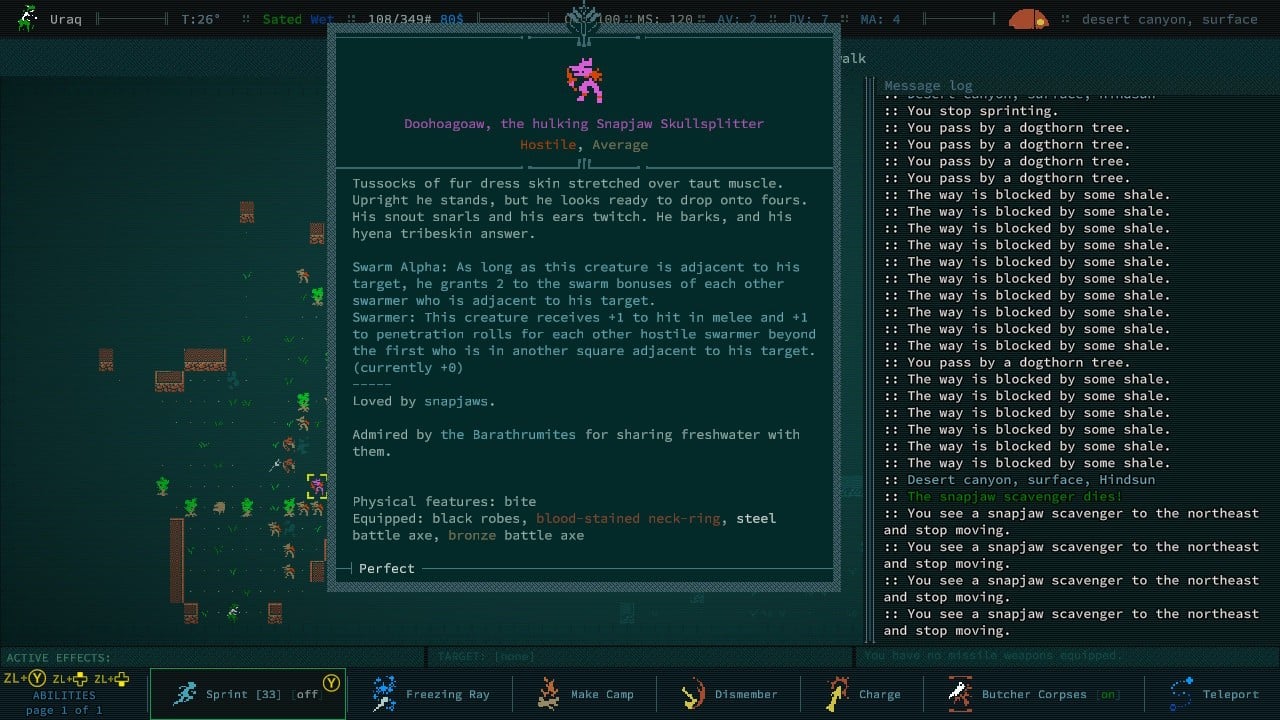
There’s a grossly unfair dungeon, and given the roguelike rules, you’d better be in the mood to laugh it off and go again. (If you’re like me, you’ll fall for it repeatedly, finally clear it, after many hours, only to discover your character’s tongue has rotted and they cannot talk.)
On the other hand, the ingenious and fan-favourite edge cases of the deep system interactions — melting through walls, falling in love with inanimate objects, becoming formerly inanimate objects — are unlikely to come about without being forced into the dire straits of desperately keeping a run going.
There are additional play modes to address this. Besides “Classic”, there’s “RPG”, which lets you save your game at settlements – not ideal as these are infrequent stops on your quest. Rounding it out is “Wander”, which means most creatures won’t attack you and you gain experience through discovery, not combat.
This is a real tension at the core of Caves of Qud: without the authored content, it would lose the wonder of uncovering a story, but without the roguelike rules, the elaborate mechanics don’t get a chance to play out. None of the available game modes really squares that circle.
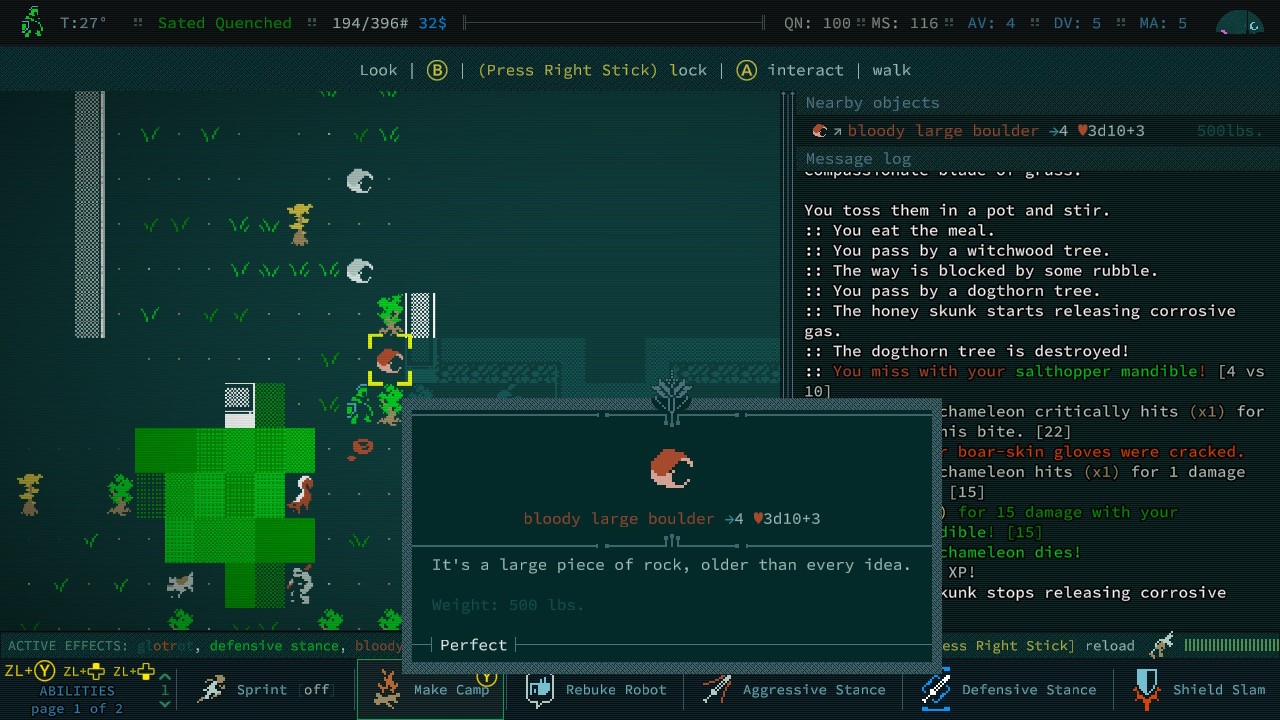
However you look at it, though, Qud is massive. The map is expansive, the systems are ornate, and the lore is compelling even before all the generated embellishments. But the interface is small. Text can be enlarged only at the expense of the play area, which itself is most effective when zoomed in. I found a playable balance, but you’ll want to consider your setup: a bigger-screened handheld, a big TV, or a monitor-on-desk scenario would probably be best – the vestiges of Qud’s PC past are clear to see.
The control scheme, meanwhile, is clever – clicking or holding 'ZR' to pass turns becomes the main interaction and it’s satisfying. Given all the behind-the-scenes number-crunching that makes the systems run, load times can drag slightly, and occasionally this translates to sluggish movement as the game gets ready for your next turn, which is usually instantly available.
Conclusion
Caves of Qud has a devoted following for good reason. Its world is vivid despite its graphical style — the wonderful music helping out — and its rapid turn-based gameplay is addictive. The hardcore roguelike approach is brutal but makes each run special. This is at odds with the main thread of an RPG quest, which demands that every run is aimed at the same goal. However, that tension provides an energy that’s hard to resist. It’s compressed a little uneasily onto Switch, but can be made to work.
Maybe not legendary status on Switch, then, but a tale worth passing down to another generation of console players.


Comments 36
I want to play this game but I don’t have it in me to spend $30.00 for it.
I see all that type and my eyes glaze over with the tiredness and resignation that only upper middle age can produce.
Really great to see this one come to a console because it’s very much a PC game in my mind, both in its UI and visual design, and in its level of depth. We rarely see a well this deep get released on console.
Thanks for the review, definitely interested in giving this at least a try (wonder how it is in handheld on Switch 2 although I could simply play it docked anyway and most likely I'll prefer one of the non-classic modes, but we'll see) - regardless, so glad this is finally also on Switch!
game looks too old for me and I'm old.
I played it a while ago on PC and it's a masterpiece for RPG lovers. The only problem for me was that it's only available in English, which isn't my native language. There's a lot to read, and the lack of my native language made the game a bit tiring.
Was waiting for the review! I love the port and devs on reddit already mentioned that they actively are working on updates and patches! Dont sleep on this title, a true gem.
This is one of the most incredible, immersive games I've ever played and getting to do so functionally on the Switch is pretty amazing! In all honestly, I doubted it would be possible but I can see myself spending more time on the Switch version than the PC over time with how I'm able to get this in before bed.
I wish it had cross save with the Steam version.
This reminds me of Dwarf Fortress, which is neat in concept, but did not have the fun factor to keep me engaged.
One of the few games that actually deserve to be calles Rogue-like. Also a masterpiece. Played very little of it but loved every second.
@kmtrain83 Same design principles, more or less, but this game has way less of a learning curve.
I’m waiting for the Japanese release, I really hope it’s coming. I really can’t wait to play this, it’s rare that games as PC-centric and deep as COQ make the jump to consoles, the Switch is truly a remarkable platform… it made it possible for so many PC-focused games to come over and find an audience that didn’t (supposedly) exist in the past on PlayStation or Xbox
A mouse mode would be so beautiful, that it might make me cry!
Caves of Qud is a game where you can look at one screenshot and know if it's for you. If you look at this and think, "I could sink a few hundred hours into this thing," you're right. If you look at it and think, "This isn't for me," you're also right. You're missing out, but you're right.
This game looks quite qud
Qud is the definition of a lifestyle game. So glad to have something of its mechanical depth on Switch.
Between this and Moonring DX, we're finally getting "Old PC-Style Game" style games on the old Switch.
@Varoennauraa supports touch screen control in handheld mode! but controller support is so good that the mouse would be much slower
ssethzeentach enjoyers rise up.
There is a general Switch accessibility option where if you double tap the Home button the screen zooms in an adjustable amount (you change zoom with X and Y). It would be useful for the tiny font. I used it loads in Case Of The Golden Idol, for example.
I'm semi interested in this, but I always burn out on roguelike games because it feels like luck whenever you advance once you get over that initial basic learning curve.
Even after reading the review I'm still so on the fence for this one. I know that if I'll get hooked, I'll be screwed, haha. I just don't think my backlog will allow me to get this game. And I completely agree with @canaryfarmer. I see the screens and all I think of is "This is what my life was like nearly forty years ago." I don't know if I can bear it, haha.
Is this game designed to be played with a keyboard - e.g. typing commands, since one apparently has a million possibilities for interaction? Or a mouse? If so then I would be interested to know how the controls translate to the console.
I've read and seen a bunch about this game but still am not quite sure how it actually plays. It seems... interesting, but I'm not sure I'd actually enjoy it.
I'm fighting the urge so bad to buy this game.
Followed this game for a while waiting for the switch launch, the systems and emergent gameplay are super deeeeeep and interesting.
Having only played it on switch 2 handheld it's essential to zoom in/out a bit (I think it's ZL+rightDpad / ZL+leftDpad) as the default is tinyyyy.
Still so much to uncover and loving it!
first death was friendly fire from my pet... I was level 1 XD
@N64-ROX there is no typing commands in this game, and on PC it has full controller support and from what I've heard it plays pretty well that way so the controls on Switch should be completely fine
I feel like id get a headache trying to read a bunch of text like that on a handheld. Or Im saying that because I have a bit of one now.
I’m tempted by this and have been for a while, but I’m not convinced I’ll enjoy it, and the price is too high to give it a punt.
An absolute must-own for me on my Switch. Always wanted to play this on there.
"Live and drink", everyone.
Been playing since launch. Someone somewhere mentioned memory leaks, and my game has crashed three times thus far. But someone else mentioned patches.
All I want to say is that I am thoroughly enjoying this game but it is dense. Are you ready to read? If you hail from CRPGs or you hail from visual novels, I think you might be able to find the brilliance hidden in this game. Just be open-minded, as they say. The caves run deep. Live and drink, friends.
I've been playing this on Steam since it's full launch and very tempted to double dip (wish it had cross save). Don't let the visuals and the first ten or so deaths put you off, this is a fantastic, deep and moorish game you'll quickly be immersed in.
I think that review is fair keeping in mind general audience. But for some of you, who liked the storytelling created by play. This is a blast immersive gem and easy 10/10 game. Devs know about crashes and patch is on the way. I myself don't find any issue with controls or UI. I find it brilliant and part of the game's magic. Yes it's true that I passed the first confusing hours on my computer.
@Sylamp cool, thanks!
This game looks like an AMAZING accomplishment... One that I will never play. Tragically, I already have my chosen timesink-style game.
@Orbphan What is your timesink-style game?
@Ironcore
World of Warcraft. I've been playing since 2004. Yep.
@Orbphan Nice, I’m the same with Gran Turismo
Show Comments
Leave A Comment
Hold on there, you need to login to post a comment...