 by
by 
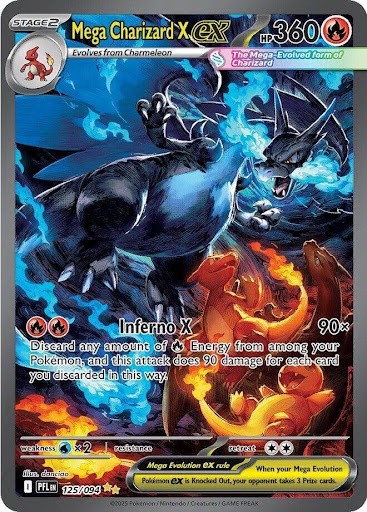
A couple of months ago, I opened a pack of Pokémon cards and pulled the super-rare 'Secret Illustration Rare' (SIR) Charizard card.
There’s even a video someone gave me of them rushing up to the commotion. “The $600 Charizard!” you can hear me yelling in the footage. My friends were cheering. It was awesome.
But there’s a big problem with this amazing memory — and it’s twofold.
First off, and embarrassingly, I probably spent a little over $600 chasing this card (even though I didn’t buy anywhere near as many packs as $600 sounds like it should be). Yikes.
Subscribe to Nintendo Life on YouTube847k
But here’s the worst part: I’m still up big.
How is that possible? Traditionally, trading cards are worth oodles on their release day, then drop in value like a brick in just days, if not hours, later. But lately, Pokémon cards have simply cut to the chase when it comes to their long-term values.
It’s wise to not read editorials for up-to-the-minute card prices, but as of this writing, which is only a short few months after this card’s release, this Charizard has a market value of a bit under $900 according to websites that track stuff like that. (That’s somehow already $300 higher than when I pulled it.)
Not only that, but if I were to have the card graded by the most famous trading card authentication and grading service, this Charizard in a 'gem mint' condition is currently fetching barely under $2,500!
So why do I consider that “the worst part”?
Well, because it’s not healthy for so many brand new, non-serialised cards like this Charizard to be worth thousands of dollars, is why. The ramifications for the product are damning.
Even compared to the infamous pandemic years, Pokémon fans can totally forget about finding cards in stores these days; adults are brawling in the aisles of stores, all while bots scrape the internet before you can buy cards online. Meanwhile, entire cottage industries have risen around ripping packs, mystery repackages, and famous (and infamous) card streamers.
Heard of the term 'recession indicator'? If ever there was one, the Pokémon TCG is it. Pokémon TCG should no longer be considered merely a fun hobby people like; it’s firmly a critical part of the world economy. And it’s acting like it.
By the Numbers
While it feels like Pokémon TCG has been non-stop booming for decades now, if you haven’t been paying attention over the past year and a half especially, the overall trading card market is now on a new level. It’s an unprecedented economic level, in fact.
This figure has been oft-reported recently but bears repeating: according to an index by Collectors (the parent company of professional grading company PSA), Pokémon card values collectively rose 282% between the years of 2004-2020, with most of that rise happening near the end, around the pandemic.
CNBC reports that the same index shows an out-of-this-galaxy 1,350% increase between 2020’s high and today.
Here’s a good way to visualise that increase. Below is a screenshot of TCGPlayer.com’s “Top 10 most expensive Pokémon cards” end-of-year recap from 2023, a snapshot in time well into Pokémon’s post-COVID renaissance. (Note: TCG Player is the de facto trading card marketplace, whose data is what much of the world derives a card’s market value from.)
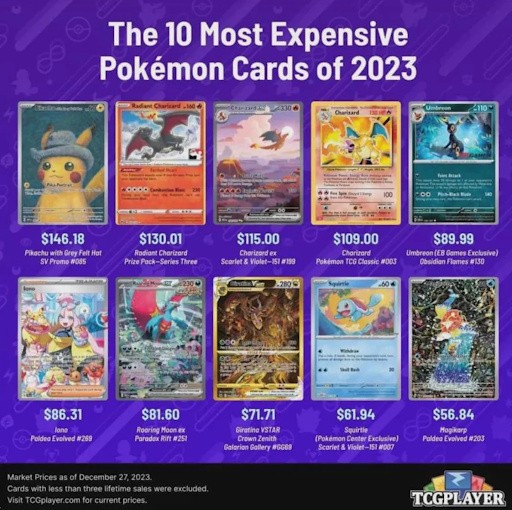
In 2023, the top card pullable from a regular pack ended the year averaging resales around $115. Almost every single top chase of 2023 was reselling for no more than double digits.
Now here’s their same list recapping the end of 2025:
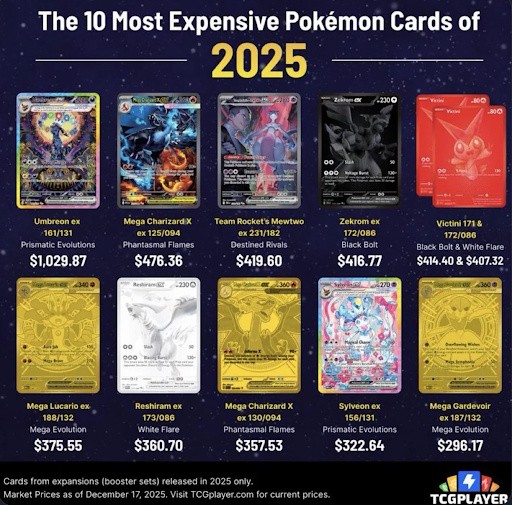
By 2025, top chases sat comfortably at hundreds, not dozens. The most expensive card, the Umbreon SIR, ended the year averaging over $1,000 resale (it’s way higher today). And indicative of this being a trend versus a handful of outliers, many sets released that year featured several cards worth hundreds, not just one or two.
Roughly one out of ten Pokémon cards that have ever existed was printed in 2025.
All the while, countless chases from years previous didn’t just rise, but compounded in value. In one high-profile example, the fan-dubbed 'Bubble Mew' card from 2024 spent a year comfortably at around $80 resale, yet today is reselling at ~$850.
Also, as you can see, that Charizard from the top of the article has nearly doubled in value already, and cards like the popular 'Eeeveelution' variants are similarly bonkers. And do you even want to know what the top cards released in 2026 are doing?
Well, too bad, because a Pokémon card value article wouldn’t be complete without mentioning that, as of this writing, the straight-out-of-the-pack resale prices of 2026’s 'Pikachu EX' and 'Mega Gengar EX' SIRs are both well over $1,350. And there are way too many cards to list from 2026 that are worth hundreds apiece, too.
If I may speak directly to you here, just for a moment: chat, we’re cooked.
What does this mean for The Hobby™?
It’s not really breaking news to sit here and report, “Number Big!” I get it. We are all numb to reading things like this.
Instead, what I wish to put out into the universe is not that this fervour should be thought of as some kind of moral failing, nor merely to say that long-time, empty-handed fans deserve better than this. (They do, by the way.)
“Recently I started speaking up online about how difficult it’s becoming for younger collectors and families to get Pokémon products because of scalping, products selling out instantly, and release systems that many kids simply can’t access,” says Oscar, a 12-year-old fan who wrote to Nintendo Life about his experience as a young collector.
“As someone who is autistic, this hobby helped me make friends, build confidence and feel accepted…I’ve seen videos of people arguing and fighting over Pokémon cards outside toy shops…I don’t think that’s the environment kids should have to be around just to enjoy a hobby.”
Agreed, but sadly I think it’s time that we all stop thinking of the Pokémon TCG as just a hobby. Because regardless of how we wish to engage with it, by definition, it really isn’t anymore.
There’s hardly anything more imperious than someone bringing dictionary definitions to a debate, but I worry Pokémon fans have been like frogs on a stove for so long that we’ve lost the plot. Thus, it’s actually worth mentioning how Merriam-Webster defines 'hobby': “a pursuit outside one's regular occupation engaged in, especially for relaxation.” The Cambridge dictionary defines it as: “an activity that you do for pleasure when you are not working”.
Pokémon TCG can be pleasurable and exciting, but playing, buying — heck, even absorbing Pokémon TCG from a distance — is hardly passive anymore. It frequently requires job-like dedication at all levels, casual to professional. (The high amount of children who can rattle off up-to-the-minute market values is at least a little disturbing.)
Those circus clips of adults fighting may have overwritten our memories, but remember that even as recently as just over a year ago, the average person could walk into a store and still find something related to the Pokémon TCG, or at least they might in due time. Cards were expensive, but they weren’t expensive. Graded cards, both modern and vintage alike, were worth hundreds.
Yet today, no non-distributor can consistently get cards, because in mint condition, many brand new (not decades old) chases are worth down-payments on cars and houses. 'Hobby' is now a misnomer.