 review by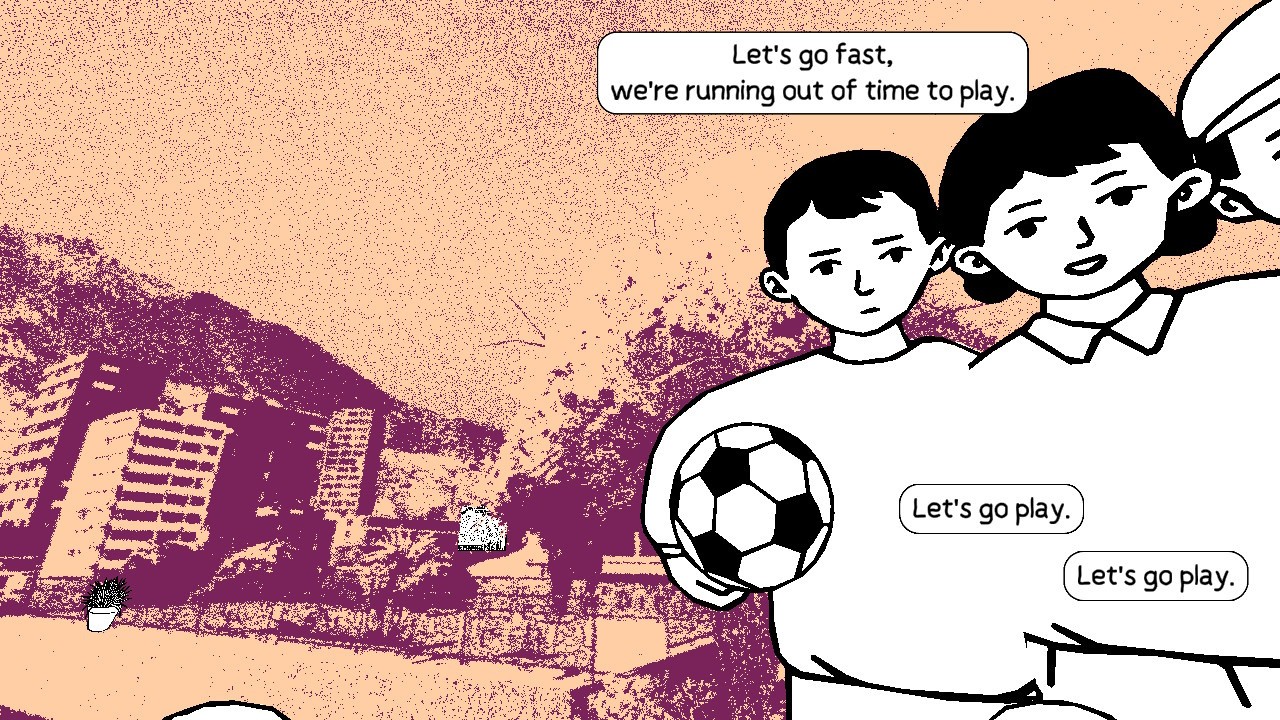
Editor's note: This game launched in North America on 11th December, but won't hit European eShops until 13th January.
For some, football is something to play; for some, it’s something to watch; for others, it’s something to be scared of in the playground. But in 2001, in Ecuador, football meant just about everything to just about everyone. At least, that’s the story told by Despelote, a game that conjures the magic of childhood and football fever and makes it captivatingly relatable.
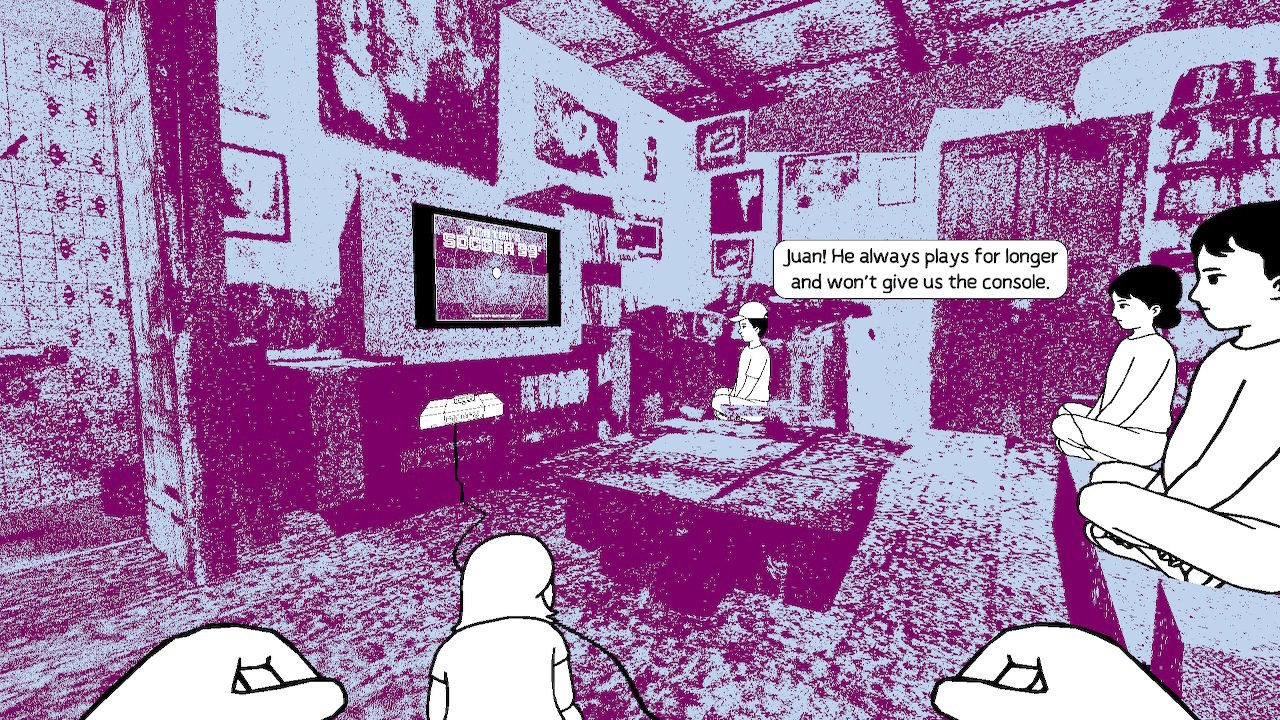
The game opens with you playing video soccer on an old console. As it’s gradually revealed that you’re sitting in a family living room, your parents’ chatter creeping into your awareness, you are connected very intimately with the protagonist of the game — its designer — Julián, a kid in Ecuador in 2001.
That year, Ecuador clinched a game against Peru, starting a journey towards first-time World Cup qualification, and everyone’s there for it. Your family are watching football, school kids are playing football at break time, overheard grown-up conversations are about football, and it’s blaring on TVs in bars and shop windows. The sense of optimism brewing around this national event permeates every aspect of life and it’s impossible not to be swept up in it.
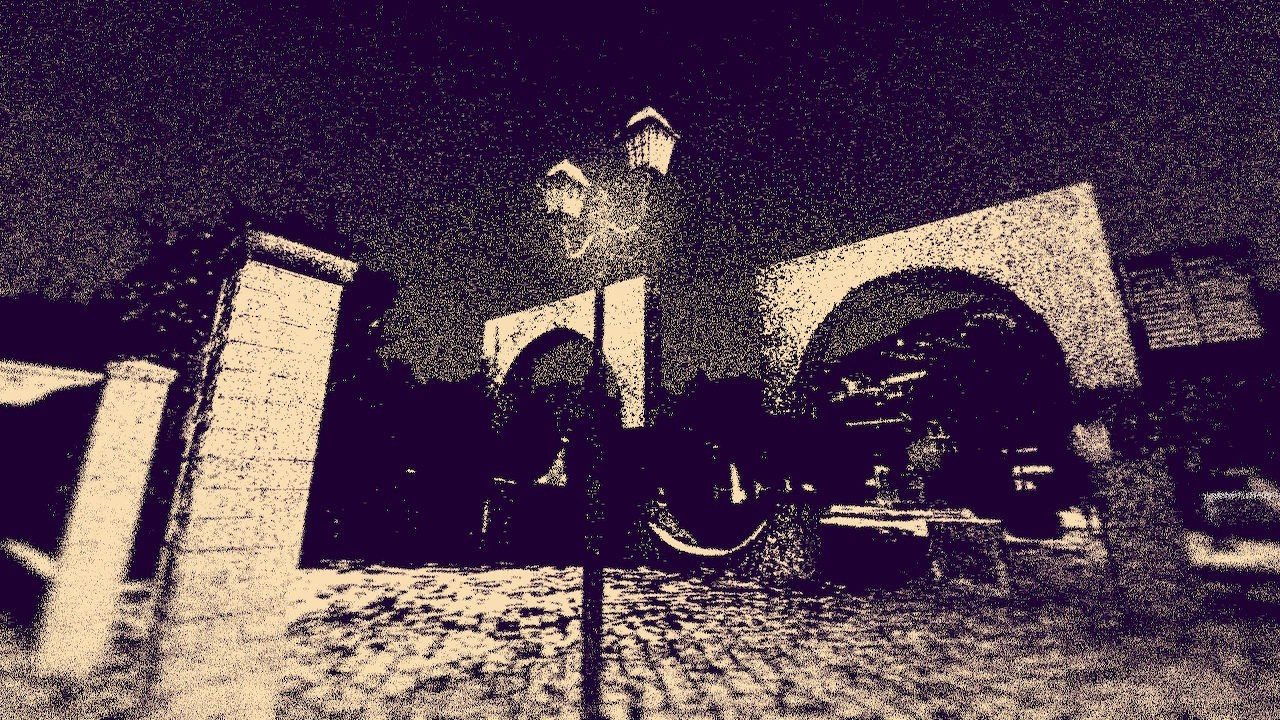
This historic moment fixes the story in place and time, creating a little bubble of childhood. The nostalgia is flavoured with small adventures, like skipping school to take in the glorious scenery of Ecuador, aggravating your teacher, and playing out too long in the rain.
Gameplay-wise, this is all delivered in a variety of ways. That opening moment of playing on the console gives you a top-down, black-and-white football game, controlled with an innovative two-stick arrangement. The game then moves into first person, your “real-world” playtime football-kicking coming to mirror the console game’s controls. From this perspective, you sit in class, check your watch, skip school, talk to your friends, and, yes, kick around a football.
Much of the time, you're just an observer, building the sense of being a kid and following whatever is set out for you by the adults in your life. You listen to lessons while you wait for the bell; you ride in the back seat and hear conversations happening in the front. Among the passive moments are a variety of first-person interactions, almost always involving or adjacent to football.
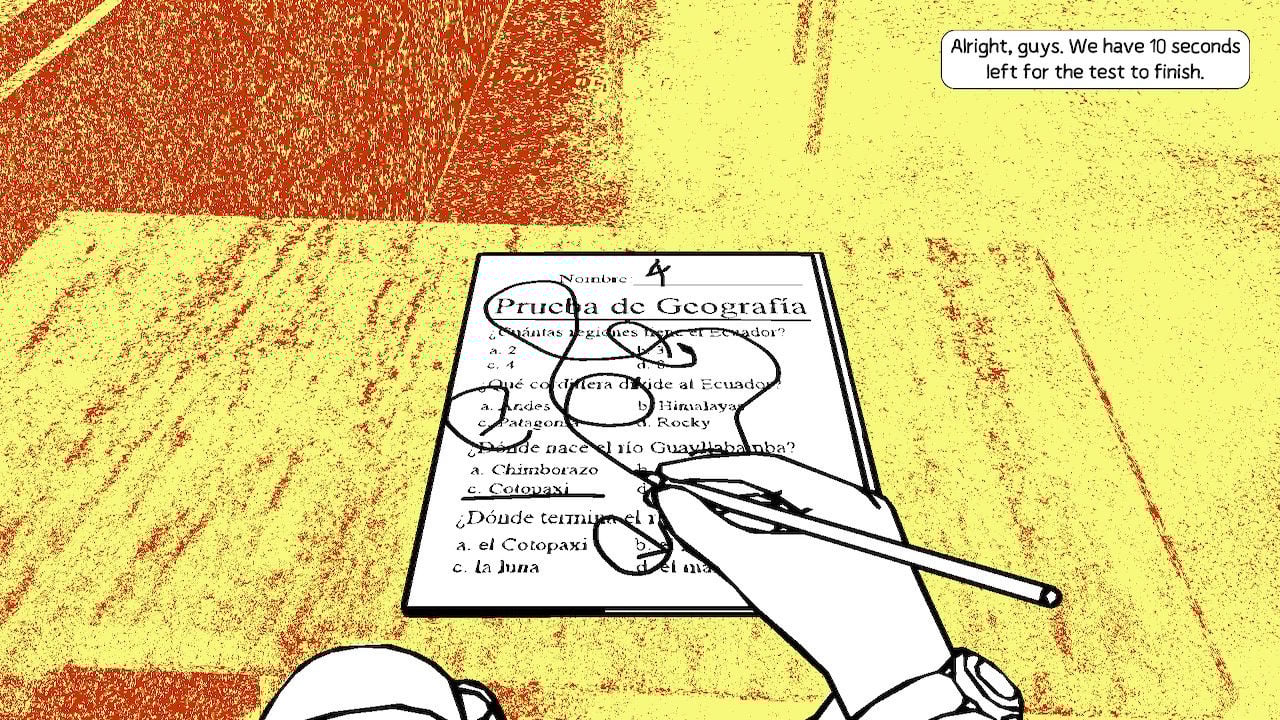
Despelote doesn’t try to riff on a central mechanic. In place of that, it develops themes of memory and childhood through a range of gameplay approaches. This keeps the experience light while making the excitement about the football feel totally irresistible. However you look at it, however you interact with it, everything is football. From Julián Cordero’s perspective, everything orbits around football, but other key moments in Ecuador’s history play out, too, from dollarisation to the country’s first showing at the Venice Film Festival.
This gameplay-light approach does mean Despelote asks for a certain mindset. This isn’t a game driven by challenge, mastery, or meaningful choice, and there are long stretches where your role is simply to exist in the moment it presents. Progress is gentle, more like turning a page of a book than developing gameplay, and the designer is happier letting scenes wash over you than pushing you forward. If you’re willing to meet it on those terms, the restraint feels purposeful; if not, this gentle vignette may feel too far from a traditional game.
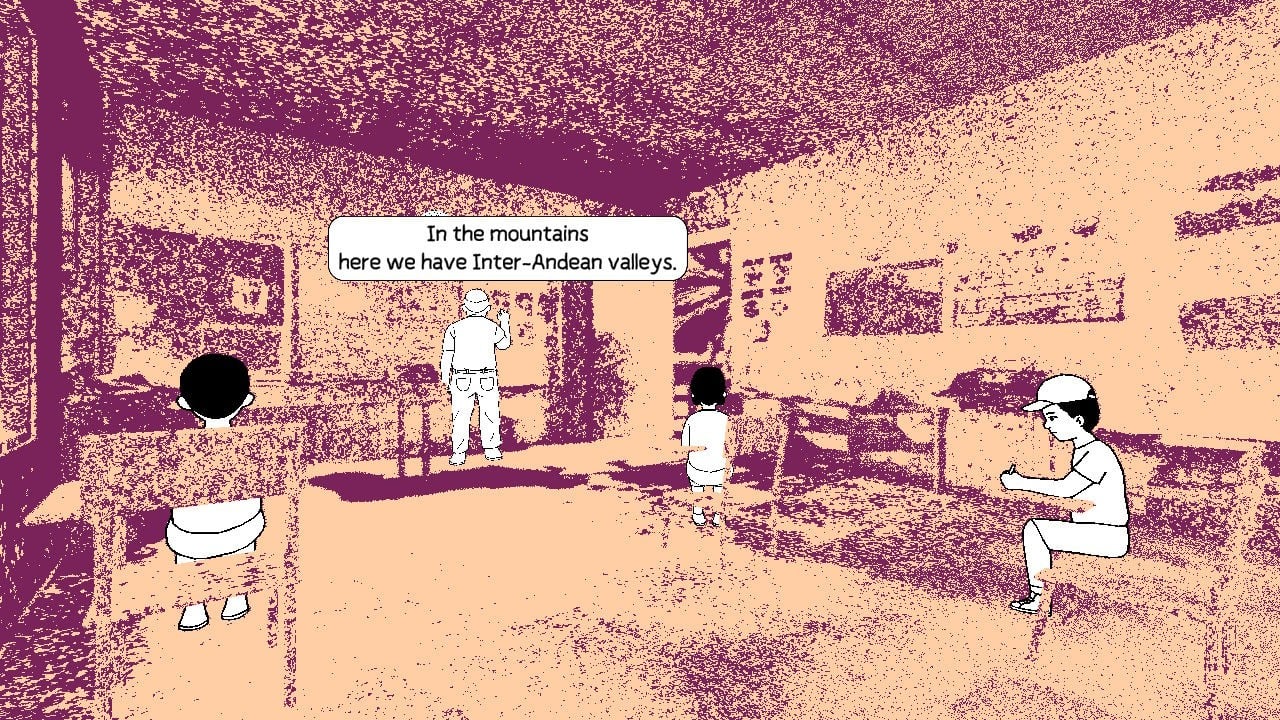
Visually, the game could hardly be more distinctive. The art, by Sebastián Valbuena, sees figures drawn by hand in black outlines on white backgrounds making up the cast of the game. They sit on top of hazily dithered two-tone scenes. This effect layered on top of the 3D environment completely disguises the level of detail in the world, its lighting and textures – almost anything that might normally contribute to overall visual impressions.
The graphics are therefore, in a sense, flawless. The art direction is expressed to its full, love it or hate it. In motion, it comes to life in a way screenshots can’t convey, and once you're immersed, the world is living and breathing. This is helped by the voicing of all dialogue and the inclusion of real video of football matches, displayed through the same vibrant filter.
All the spoken language is Spanish, with English speech bubbles written out onscreen. This adds beautifully to the sense of place and authenticity; I was transported to Ecuador and my imagination ran with it. Meanwhile, active sound effects and incidental sounds lift the realism of the world. Music is relatively sparse and often diegetic, with key moments of wistful guitar – but this contributes to a matter-of-fact tone that doesn’t overegg the emotional heart of the story. And an emotional response is what the game is all about. Yes, football provides a pitch for it to play on, but this is a relatable story even to someone with no interest in the sport.
A slightly dry tone also makes room for some light humour. With Despelote, Cordero doesn’t take himself too seriously. A lack of self-importance places the protagonist as just one thread in the tapestry, which again builds a sense of a moment in history. A remembered story is always one you can’t alter, so drifting through this autobiographical account makes total sense. That said, if you’re looking for greater agency or action, maybe this won’t quite be for you.
It’s to Cordero’s credit that they also knew when to stop. The game tells its story without padding, then ties it in a bow and bids farewell after just a couple of hours. It lands as a complete work and can’t be criticised for being short – but bear in mind that this is not some open-ended adventure.
Conclusion
With its distinctive presentation and light-touch mechanics, Despelote builds a mesmerising feeling of a community brought together by a fleeting football obsession. The historic moment of Ecuador’s journey towards World Cup qualification grounds the story in time and place, perfectly capturing the author’s salad days. Whether you play, watch, or avoid football, this is a beautifully-told story you can enjoy.


Comments 18
Glad this one turned out great. It looked thay way from the first trailer. It really stands out as a piece of latin-american art. I'm from Argentina and I can feel the themes, even if I'm not a football fan myself.
Thanks for the review, as usual the short running time is actually a positive for me personally (can see where you're coming from though and of course it's worth mentioning anyway) and practically everything else also appeals to me so I'm looking forward to giving despelote a try even more than I was when it comes out also here in Europe and I have the time for it - easier than for other games exactly considering the abovementioned, but we'll see when I actually start playing it!
@dartmonkey There's a typo when you can fix it, "the protagonist of the game — it’s designer —".
Oh my goodness, I saw this at The Game Awards. I'm not big into soc- ahem I'm not big into footie but I am HUGE into short games with heart and lovely art styles. Definitely giving it a shot
This looks/sounds exactly up my alley! And, as Johnny said above — a short runtime on a quality game isn't a deterrent for me but a "selling feature" in these oversaturated times!
I hope not to forget about the game when it finally hits the european eShop!
Great review and sounds like a very interesting idea. On a separate note but regarding reviews: are NL planning on reviewing Rogue Prince of Persia!? It’s unlike NL not to have a review of such a game live yet, and I am delaying my decision on purchase…
Like others have said, a couple of hours of gameplay is a plus. If I end up not liking it, at least I haven’t wasted too much of my time. The reviews for this game have been overwhelmingly positive, so I’ll put it on my wishlist and likely play it at some point in the Switch 2’s lifespan.
Soccer? I barely know her.
"Can't be criticized for being short." Proceeds to mention brevity under "Cons."
I had no idea this game existed, but the reviews and comments section sold it to me!
Looking forward to this coming out in Europe! As three others already mentioned, a short runtime is not always a negative especially for this type of game
@Dr_Corndog lol.
(I guess a neutral ”Of note:” part beside the joys and cons could be something for the future, or a fact box that includes an estimated runtime. To be fair, the phrase ”Be aware” is likely an effort to make the con more neutral, but still funny )
This looks and sounds amazing. I always enjoy a well executed walking simulator so I'll definitely be grabbing this.
@mackers84 I know, I pointed it out exactly because originally it was "it's" (I quoted it exactly as it was, only added the italics to pinpoint the typo) - luckily not long after that they fixed it so now it's the correct "its"!
@JohnnyMind thanks for catching that!
@Robokku You're welcome and again, thanks for the review!
@mackers84 No worries and thank you!
Show Comments
Leave A Comment
Hold on there, you need to login to post a comment...