
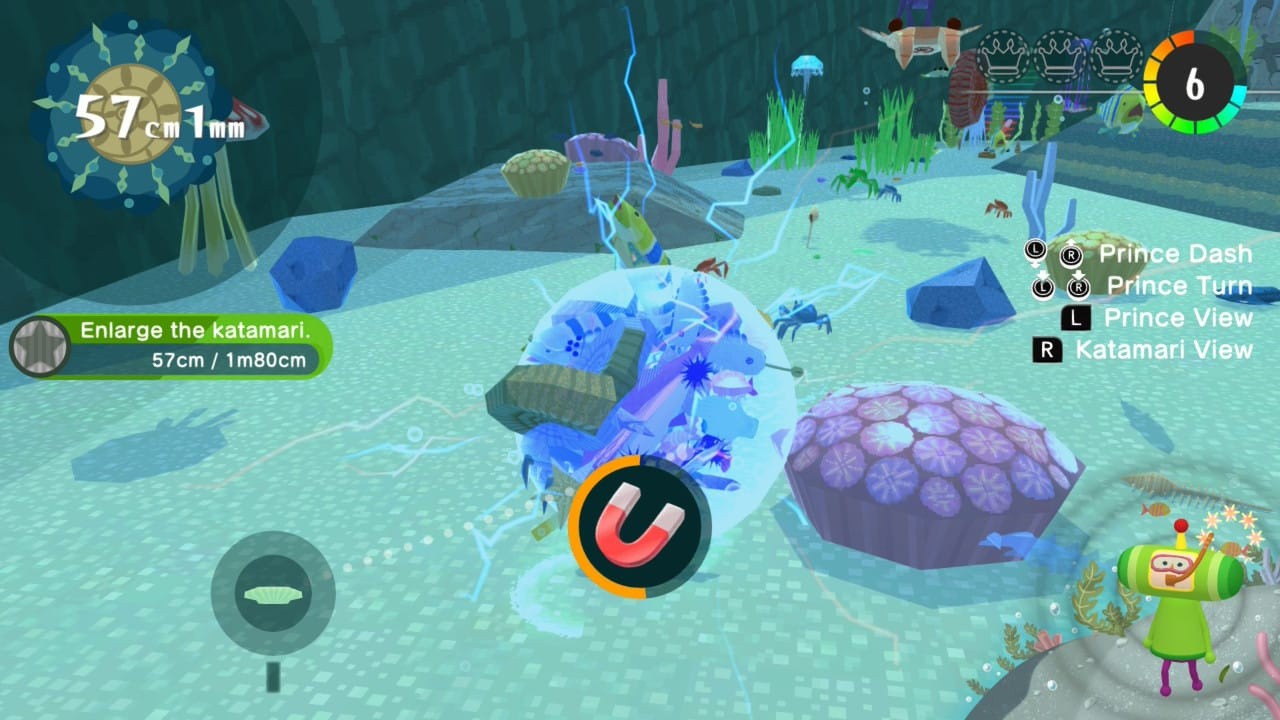
The core gameplay conceit of the Katamari series — rolling up everything you see into a giant ball of wriggling debris, one object at a time — almost feels like it shouldn’t work. Yet Once Upon a Katamari manages to turn mess into something meditative, pulling you into a satisfyingly tactile flow state where hoovering stuff up feels as good as popping bubble wrap.
For the uninitiated, the main objective of Katamari games is simple: roll your katamari (a Japanese word meaning 'clump' or 'mass') over objects smaller than itself. These objects stick to the ball, making it grow progressively larger, which in turn allows you to pick up bigger things, starting from thumbtacks and ants and eventually rolling up buildings and clouds.
If it sounds surreal, it most certainly is. Pair that with psychedelic low-poly visuals, plus a soundtrack that veers from sugar-high J-pop to cosmic funk and an absurdist story where a flamboyant, god-like king haplessly destroys the cosmos and sends you to Earth to roll everyday things up into new stars to restore the heavens, and it’s clear you’re not in Kansas anymore.

Hopes were understandably high that this new entry, the first mainline Katamari game in 14 years, would tap into what made the original Katamari Damacy and its direct sequel on the PlayStation 2 critical darlings, particularly given that later entries in the series arguably saw a bit of wear on the formula and lacked the same degree of broad acclaim.
Once Upon a Katamari does just that, picking up right where the early-2000s classics left off. It remains faithfully true to the core rolling formula, but with more refined controls and a clearer emphasis on replayability with heaps of stages, collectibles, and objectives. It also offers some fun new gameplay wrinkles, making it feel like a true continuation of a beloved series.
Players can choose between the classic dual-analogue scheme, which could feel awkward at first yet can be quite precise with a little practice, or a new Simple mode that streamlines movement to a single stick. There are added camera tweaks, such as an X-ray view when you’re obscured by obstacles and surroundings, and handy shortcuts for dashing or repositioning the katamari.

New to the mix are power-ups called Freebies, which offer short bursts of utility without upsetting the game’s balance: pick up a Magnet to pull in nearby objects, a Stopwatch to freeze time and roll up fast-moving targets, use Sonar pings to locate hidden goodies, and fire off Rockets to propel your katamari forward in a high-speed surge.
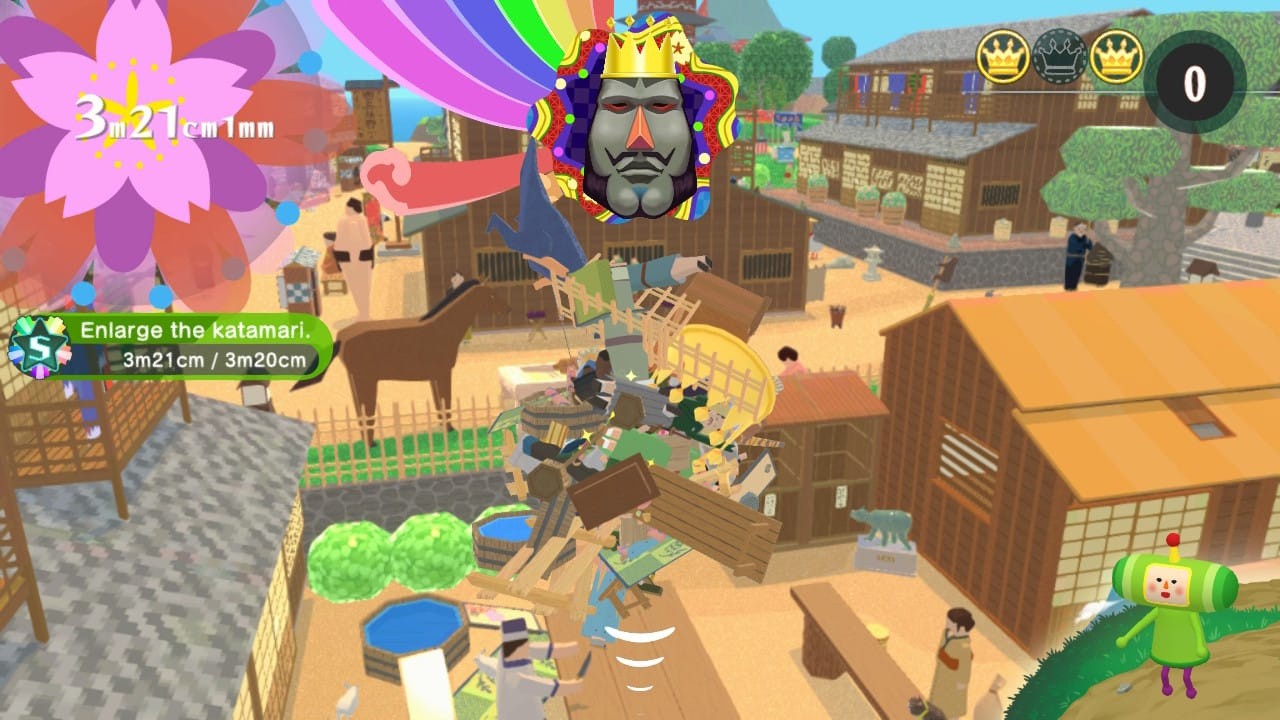
This entry sends players time-travelling through whimsical historical backdrops — from Edo-era Japan and ancient Greece to the Wild West and ancient Egypt — each era brimming with thematic clutter to roll up. Together, the refined controls, new power-ups, and vibrant technicolor settings make this feel like a faithful continuation with a modern sheen.
Levels are tackled in short bursts of typically two to ten minutes or more, and each one has its own objective, like reaching a certain size before time runs out or gathering a specific item type. Each diorama-like stage brims with collectibles, too, including dozens of Cousins who can be unlocked as playable characters, along with hidden Presents and three shiny Crowns.

The combination of multiple, usually well-hidden collectibles with optional challenge variants that remix objectives makes every map worth revisiting. There’s a pleasing amount of content on offer with around 50 stages. It takes roughly 8-10 hours to beat the main game, but completionists could easily spend hours more rolling up every corner of the map.
Between levels, short cutscenes showcase the series’ trademark absurdity with slapstick humour that will feel instantly familiar to returning players. That said, the verbosity of Katamari’s cosmic ruler can test your patience, feeling somewhat intrusive when his face and dialogue text box overlays the screen during gameplay, which can itself be a sensory overload at times.
There are moments when your katamari grows too large in confined spaces and gets wedged between walls or obstacles, resulting in being a bit stuck until you find a direction to wiggle free. The camera does its best to follow along, but can sometimes be an irritant in such moments. These quirks, however, are baked into Katamari’s DNA and don’t meaningfully ruin the fun.
Once Upon a Katamari includes an online multiplayer mode called Katamari Ball, which functions as a light, competitive side mode that can also be played against AI opponents. Four players race to roll up the most items in a shared arena, periodically depositing their haul into a UFO beam to bank points and shrink their katamari back to a nimble size.
The bigger you grow, the slower you move, a trade-off that encourages bursts of scoring, though if you’re large enough, you can roll up your opponents for extra points. The end-of-round scoring, complete with random bonus categories, feels straight out of a Mario Party, making for a fun palate cleanser between the solo main campaign. Couch co-op is sadly unsupported.
We received our review code shortly after launch, which meant I was able to properly test Once Upon a Katamari’s online multiplayer mode under real-world conditions. Matchmaking was quick; we were paired with live players within moments of initiating a session. Online play felt stable and responsive, with no noticeable lag or connection drops.
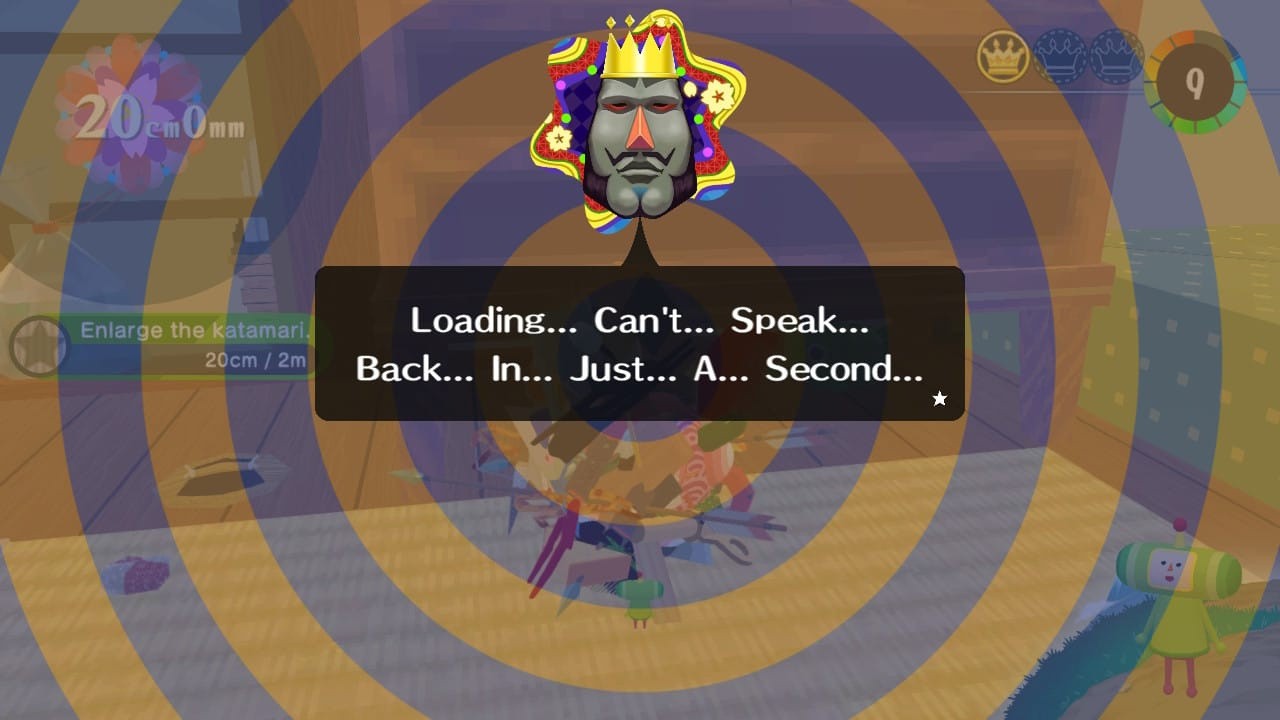
Performance is relatively smooth across the board on Switch 2 and the base Switch model, with the latter more noticeably dropping frames during busy moments. Load times are brief, around two to three seconds, but occur mid-stage when the game expands your playable area when you increase your weight class, causing a brief pause before snapping back into the action.
Switch 2 smooths over the edges further, with seemingly faster transitions and steadier performance, though there’s unfortunately no bespoke optimisation for the newer hardware. Graphically, the game’s low-poly aesthetic looks crisp and vibrant with minimal pop-in. The saturated, dayglow palette also looks great in handheld mode on the Switch OLED.
Conclusion
Once Upon a Katamari proves its worth as a mainline sequel and differentiates itself from other action-puzzlers with its irresistible game feel.
Rolling the katamari and sticking things to its surface with a satisfying pop is a continuous, sensory delight not dissimilar to vacuuming up gems in Vampire Survivors. Refined controls and the introduction of power-ups like the Magnet simply enhance this core experience, making for a deeply satisfying roll ’em up.


Comments 35
Will pick this up eventually. Have got most of the others and the humour is usually on point
My favorite, most repayable franchise. This was so unexpected and I'm so happy with how it turned out.
Should the first paragraph say "the core gameplay concept", or is there a use for "conceit" I'm unaware of?
Anyway, seems like this one is worth picking up in the future. I enjoyed both Katamari Damacy Reroll and We Love Katamari Reroll + Royal Reverie.
"it’s clear you’re not in Kansas anymore" : )
Apart from that, the game looks like a psychedelic collectathon, but a collectathon still. Isn't this a bit boring ?
An FYI to European physical collectors.
This one is getting a PEGI physical release, but it's a month delayed compared to the US ESRB and JP CERO releases for whatever reason.
Thanks for the review, looking forward to playing this even more than I already was on Switch 2 - my copy has already arrived so now it's exclusively a matter of finding the time for it (and after playing this I'll finally go back to playing the remasters of the first two games luckily also on Switch instead of having just watched others partially playing them)!
I'm excited to pick this one up, though I'm not sure if it'll be too soon. Perhaps Christmas time will yield me some roll-em-up fun!
This is a must buy for me!
@RupeeClock I'm from Italy and my copy has already arrived (preordered it from the Italian Amazon) - it's worth mentioning that it has Italian, Spanish and Portuguese writings on it so my guess is that the physical release has been delayed exclusively for European countries speaking other languages.
@dartmonkey As @Tyranexx pointed out, there's potentially a typo when you can fix it, "The core gameplay conceit of the Katamari series".
Yay! I had fun with the original reroll.
@JohnnyMind
Interesting, you mean that English language European releases may be delayed?
I wonder if it's a multi-region release, where the title software is identical across releases, and changes language based on your Switch system's language setting.
@Tyranexx "Conceit" is kind of like the noun form of "conceive." It has essentially the same meaning as "concept," but that word came later.
Love the old ones, definitely getting this one. I hope the music is as good as the old games, that was always part of the charm too.
@Tyranexx Conceit has multiple definitions, one being "an artistic effect or device". In other words, it's correct.
Yes, conceit is correct.
@RupeeClock Yep, the software itself is in English, German, French, Spanish and Italian according to the information on the back of the box - the same ones mentioned also on Nintendo's site (so exclusively the usual European languages, too bad that Bandai Namco doesn't include other ones starting with original Japanese in their European releases for those like me interested in that)!
@dartmonkey Interesting, I've never heard it used that way either - thanks for telling us and sorry that I tagged you (hope you won't mind me doing so again although this time to thank you)!
For me, this is the best game released this month. Absolutely wonderful return to form for Katamari.
ROYAL RAINBOW I would love to see The King of All Cosmos and The Prince to be playable characters in the next Super Smash Bros, please.
I've always been intrigued by Katamari, but never gave it a try.
Still intrigued though.
@Potimarron the words KATAMARI and Boring do not even exist in the same sentence, let alone the same Universe. KATAMARI games are an absolute good and will always charm, delight and inspire legions of new fans with each playthrough! ROYAL RAINBOW INTENSIFIES
Anyone know if there's a zen mode that lets you freely roll up stuff at your own pace? I like the timer challenges but I've always felt this game is such a good chillout game. I know the older games had "Endless Modes" but they were usually the last thing to unlock.
@TheBoilerman man it's so unlike anything else, just such a zen game
@mouseclicker, @Gabe250 Ah, I see. I've never heard or seen the word used this way - hence why I left my comment open to correction. I was only familiar with the "excessively proud of oneself" definition. I learned something today, so thank you for providing context!
@JohnnyMind Seems like we both learned something new today. All the same, I appreciate you tagging Gavin for any potential corrections!
Hey what, this is a new Katamari game? For some reason I saw this on the eShop and thought it was a remaster of the Xbox 360 one which left me cold for some reason. I forget what that reason actually was (it may have just been a combination of exhaustion from completing the PS2 originals, and sadness that my exquisitely Japanese hidden gem game was now being marketed to the masses on the disgustingly American Xbox) but apparently it wasn't just me if this reviewer says that this new one is a return to form.
Upgraded from "eternally wishlisted" to "will buy at some point"!
Still more than three weeks before my physical copy drops.
Hoping this gets some Switch 2-specific optimization down the line, because I'd have otherwise already picked it up.
So glad it turned out good! Just finished the original again aka reroll. Such a great game
OMG, I was afraid it would be a bland sequel! Apart from the remasters, the last Katamari I played was Beautiful Katamari on Xbox 360 (and it’s still my favorite). It’s just a shame there are slight loading times when the world expands, since those didn’t exist in the Xbox 360 game and the Switch 1 is much more powerful!
Physical copy is gonna be mine anyway ❤️
Cheers for the review.
The Katamari series continues to be fairly highly rated on the Switch consoles it appears. Woah.
Good read.
I love Katamari games but they're crazy hard. I enjoy myself tremendously the first few levels, then suddenly, I can't finish in time, no matter how many times I try.
This type of game should be about fun but ultimately, it always gave me more frustration.
I hope this entry has a milder difficulty and it can be enjoyed just for fun.
Give me a Switch 2 patch for 60fps/1080p portable and I’m 100% in. This would’ve been a day1 purchase for me, but not like this.
@Potimarron These are some of the most enjoyable games I've ever played (I still listen to the soundtrack from the first two games, decades later). If you haven't played them, I would recommend picking up the older titles first, but I personally find them to be pure gaming goodness.
@goomba478 Thanks for the input !
Show Comments
Leave A Comment
Hold on there, you need to login to post a comment...