Game Review

Avatar

Dragon Ball Z: Goku Densetsu (DS) Review

Europe Mon, 24 Sep 2007 by Thomas Bowskill

Cardmehameha!

Sorry, I had the overwhelming urge to begin this review with a play on words involving DBZ and cards… and that was the best I could do!

Anyway, to the point. Dragon Ball Z is quite easily the most recognisable cartoon to come out of Japan. I remember the days of my childhood where I would wish to have the strength of Goku, the healing powers of Piccolo, and the bad-ass attitude of Vegeta. So seeing another Dragon Ball Z game out on the DS put a smile straight on my face. This new game, Dragon Ball Z: Goku Densetsu, is card based- a striking contrast to your usual frantically fast paced beat-em-up’s that DBZ games are renowned for. Time to see whether or not this bold step was pulled off successfully...

I'm sure at some point all of us have played, or at least observed, a card based battle game; Magic the Gathering, Pokemon, Yu-Gi-Oh, or even Top Trumps. We all know how they work, and at the basic level Goku Densetsu is exactly the same: You are outfitted with a deck of cards that you use to move around the map and battle with your foes. These cards all have varying functions and stats which indicate how powerful they are- the stronger the card, the stronger you become in battle, simple.

I think it is safe to say we all understand this concept, so I will move on to the specifics of this game of cards. There are two modes to the game; story and versus. Story tells the story of Goku, Gohan, Piccolo, and the unlockable Vegeta- following it in a way that only fans will be able to understand all of what is going on. Versus simply lets you play upto 3 other DS owners in a battle. At the core of DBZ:GD are the types of card you can have; attack, energy, training, reverse, use item, event, and hide. There are also cards with 'Z value', which allows the player to select any type/ use an action at the strongest possible strength. Where the game differs from your normal game is at the function of the cards; each card in the deck has a double use- in battle and out of battle. I will explain in battle first...

In battle; an attack card will do damage to an opponent, an energy card will raise the strength of your cards at hand, training will raise the defence values of your cards, use item will let you use one of the items you have picked up in your adventure, event will summon another character to do an action on your behalf, reverse will swap the power value of you and your opponents cards, and hide will let you flee from the non-necessary battles.
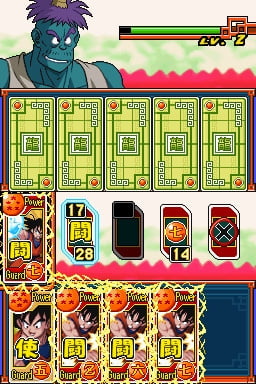
So you have entered a battle with the enemy, what happens next? Well, on your bottom screen will be 5 random cards; with one of the 8 action types attached to it. On the top screen you will have the enemy, with their HP, level and cards (albeit face down) showing. Unlike how you would normally expect it, these battles are not turn based. Instead, both characters will make their move at the same time and the card with the higher strength value (indicated by stars of the Dragon Ball on the card) wins. This winning card is the only one that will be used in the round. So if I were to place an item card with a strength value of 7 and the enemy placed an attack card with the strength value of 3, I would have the stronger card- meaning I make the only move of the round and use my item. When it comes to attacking there is another statistic involved; guard. If we use the previous example, but this time changing my item card to an attack card, what would happen when the opponent loses in strength is the guard value of their card would be taken into account and will reduce the damage they receive, based how strong the guard is. So in theory, even if the strength value was lower, if the guard value was high then the enemy could avoid taking damage- or at least sharply reduce how much was taken. There are combination moves you can also perform- when statistics from cards complement each other. There are some more rules to the game, helping it develop a bit more of a strategic edge.

The trouble with the battles is that, while the card system is well thought out, the pace is slow and the animations that accompany fights are basic to the point where you really don't feel they are battles at all- Dragon Ball Z is all about fast paced and frantic fighting action, not characters that hardly move at all! It’s disappointing to see the characters I loved as a child made to look less cool… although part of it might just be me growing up. But one thing I know for sure is that you cannot edit the cards you carry around with you, and that was a dire mistake. I remember, when I used to love these kind of games, I would spend hours developing and refining my deck of cards- it was easily the most enjoyable part of a card game. So to see this completely ignored in Goku Densetsu is quite worrying.

From time to time you will also get incredibly frustrated with the touch screen controls. I found out on several occasions that the touch screen selection method is not too accurate- especially when it used a totally different card to the one I selected. This got to the point where I gave up on using the touch screen and reverted back to the traditional button hitting; which, to be fair, did not really make much of an impact on playability.

Outside of battles, the functions of the cards become slightly different... See, in order to progress though the story, you need to move around a map of the level. These maps contain a series of connected linear paths that lead to the end goal. To move along these paths you need to use cards- the same ones that you use in battle. The paths you progress along are like those of a board game- a series of steps, each representing one move. The power value of the card used will determine how far the player can move. If on your turn an enemy decides to randomly attack you, you have the chance of avoiding this, so long as the card you used to move has a higher guard value than the opponents attack. This adds a tactical edge to moving around the map, especially when you are low on health. Just like in battles, each card type used will have a different effect; using the attack card lets you attack first, the energy card will increase your strength for a turn, training raises defence for a turn, reverse will swap out your entire hand of cards, use item will let you use an item (no surprises there), event will cause a friend to bring you an item, and hide lower the chances of a random encounter.

Occasionally on the map you will encounter events; which differ from visiting an item shop to healing points. You will also come across some enemies and obstacles that simply cannot be avoided. Really though, all the map does is provide a break from otherwise constant battles... and occasionally give a bit of information on what's going on in the story. In a nutshell, it feels shallow- lacking any significant depth.

Conclusion

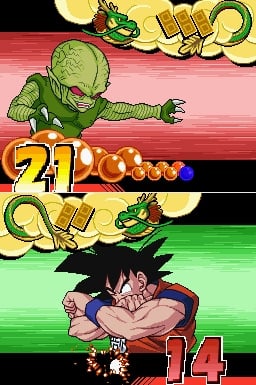
[screenshot=468bc209cfa94]This Is A Saibaiman... You Will See LOTS Of These Guys[/screenshot]Lacking significant depth is the phrase that sums up most of this game really. The music is aright; bearable but repetitive, and the visuals are not at the standard of which they should be. The card system is a nice touch, but the strategic element gets killed by the fact you do not have an actual deck; all cards just appear randomly. You can level up in the game, to increase your chances of getting different types of cards, but the choice in what you can level is limited and left partially to luck- not the best of moves in my opinion.

Regardless of these comments, the younger gamers who watch Dragon Ball Z and collect cards will love this title. For those of us who are a bit older, there is nothing that will be able to challenge our minds or rekindle our childhood memories. Kids, give this a go if you are a Dragon Ball Z fan. Adults, I think its time we moved on from this franchise.

The bottom line? The game isn't good or bad; it sits squarely on the average mark.

User Comments

No comments yet... why not be the first?

Leave A Comment

Please login to post a comment.