 review by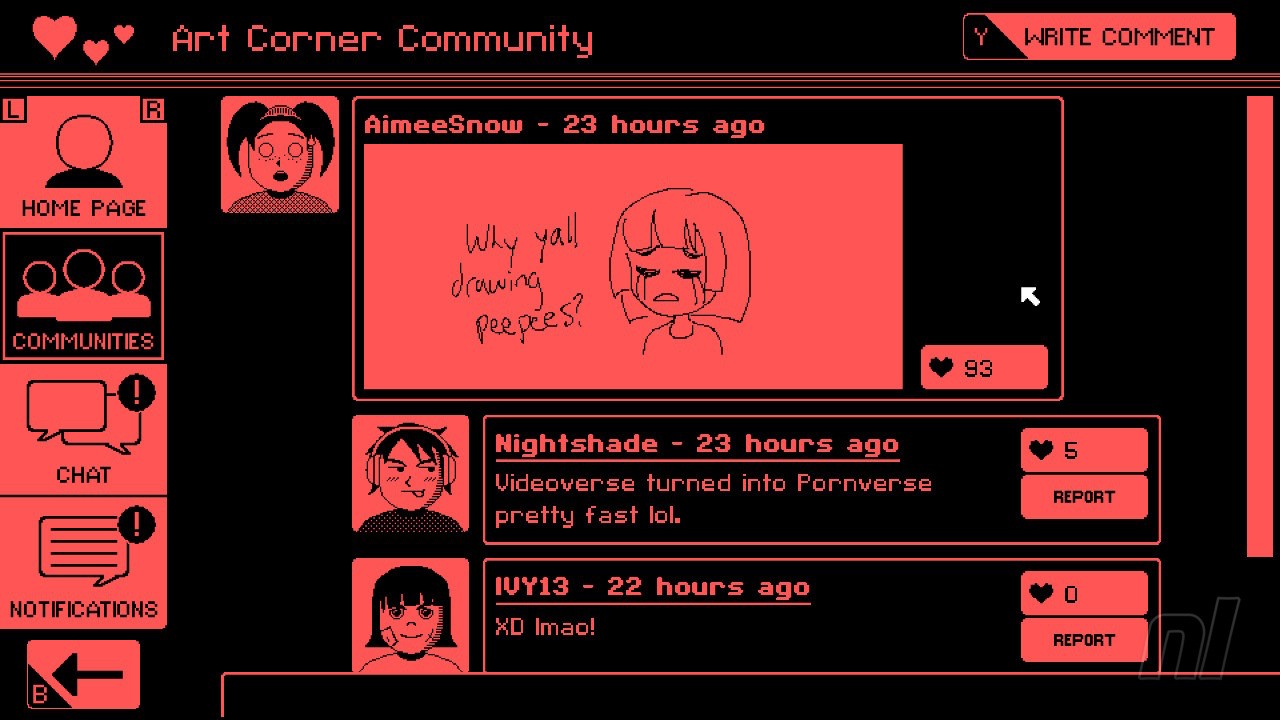
Video games are good. The internet is good. Sometimes, it’s hard to remember that nowadays, but Videoverse — the second visual novel from Kinmoku — is determined to remind us of the impact of online communities and the relationships we forge through playing video games. It’s also the most accurate depiction of online life in the mid-2000s I’ve ever played.
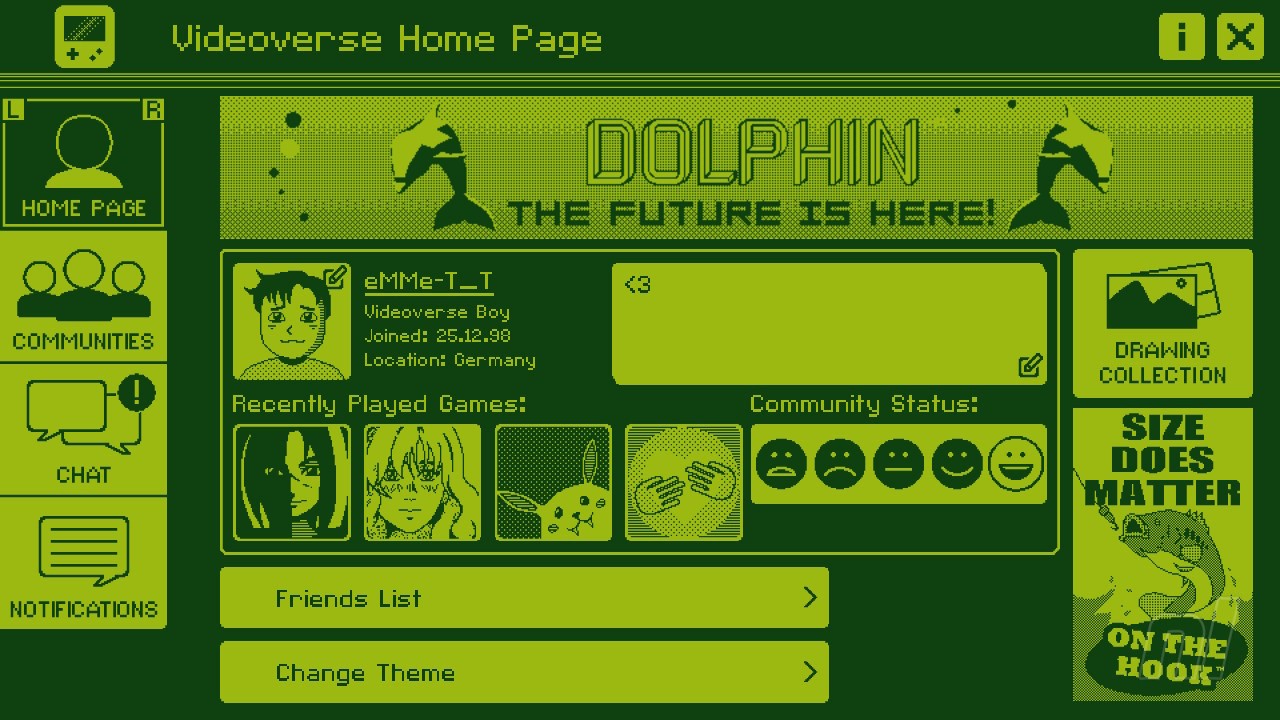
The year is 2003 and Emmett is a 15-year-old German kid who loves his Kinmoku Shark, a fictional games console that is essentially a desktop Nintendo DS. He’s playing Feudal Fantasy, a game recommended to him by one of his online friends. He also spends a lot of time on Videoverse, an online social platform akin to something like MySpace or ye olde message boards; think Steam, but cooler with pixel art avatars and two-tone colour schemes.
The majority of the game takes place in Videoverse, where Emmett chats with his friends about games and users post messages and Miiverse-like doodles. Here, you can respond to messages, ‘like’ drawings, and DM your friends.
The game beautifully allows you to foster a positive environment by choosing how you respond. These responses can lead to small quests that you can follow in the background. But even when there was a chance to be a little meaner, it always felt wrong. I couldn’t bring myself to put down a stick-man drawing at any point. Why should I? I know what it’s like to be on the receiving end of nasty comments online.
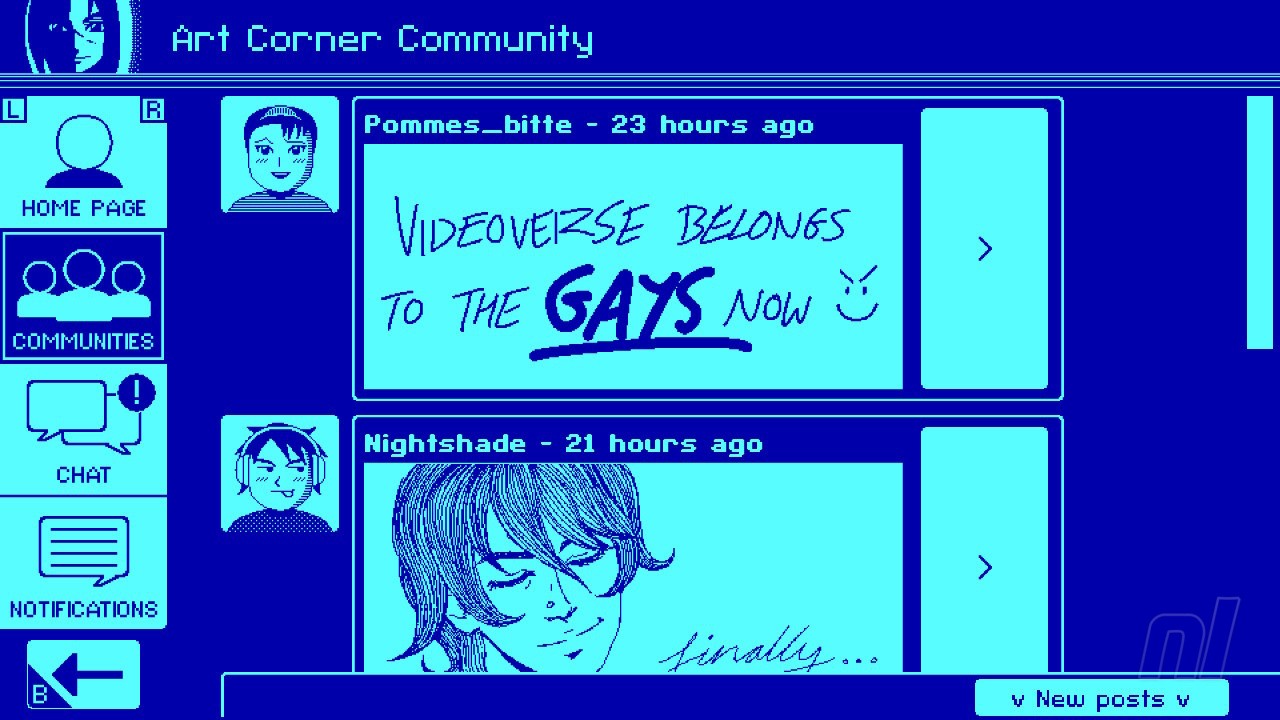
But Videoverse doesn’t shy away from the sour side of the internet; after all, the Shark is an ageing console, and with an upgraded model (the Dolphin) on the horizon, the devs slowly start to pull away from Videoverse. As a result, moderation starts to slip, and hateful messages, ranging from homophobic insults to ableist comments and lewd drawings, trickle through. A space once considered safe to so many, where they could proudly proclaim their sexuality or escape from real-life troubles, suddenly becomes toxic and hostile. Tempers bubble over, anxieties flood the art pages, and relationships fray.
It’s scarily accurate, and you can see just how that side of the online world has exploded over the past two decades. But Videoverse remains emphatically positive in the face of hate: I reported every nasty message I saw, and I always tagged other players and lifted them up when they felt down. Kindness is always the right thing to do here, and the writing is beautifully accurate to the 2003 time period. I was (and still am) a liberal smiley face user back in the mid-2000s — though there was a bit more XD and ^_^; than (: — but it’s all here in Videoverse, complete with typos and abbreviations.
Along with the writing, the general aesthetic goes such a long way to selling the nostalgia of the era. The interface is all 1-bit with bold colours (and changeable themes you unlock by commenting and reporting), customisable avatars, and lo-fi music that clearly evokes old gaming lobbies and chill spaces. Special shoutout goes to the incredible Feudal Fantasy animated cutscenes that help frame the entire narrative, too.
Sadly, navigating Videoverse on Switch can be a little cumbersome. You can use buttons or touchscreen, but both have drawbacks. Moving a cursor around the screen with the analogue stick is sluggish and fiddly; sometimes it disappeared mid-conversation, while other times it was distracting. The touchscreen is better, but it's so easy to select the wrong option or accidentally skip dialogue as you click through options.
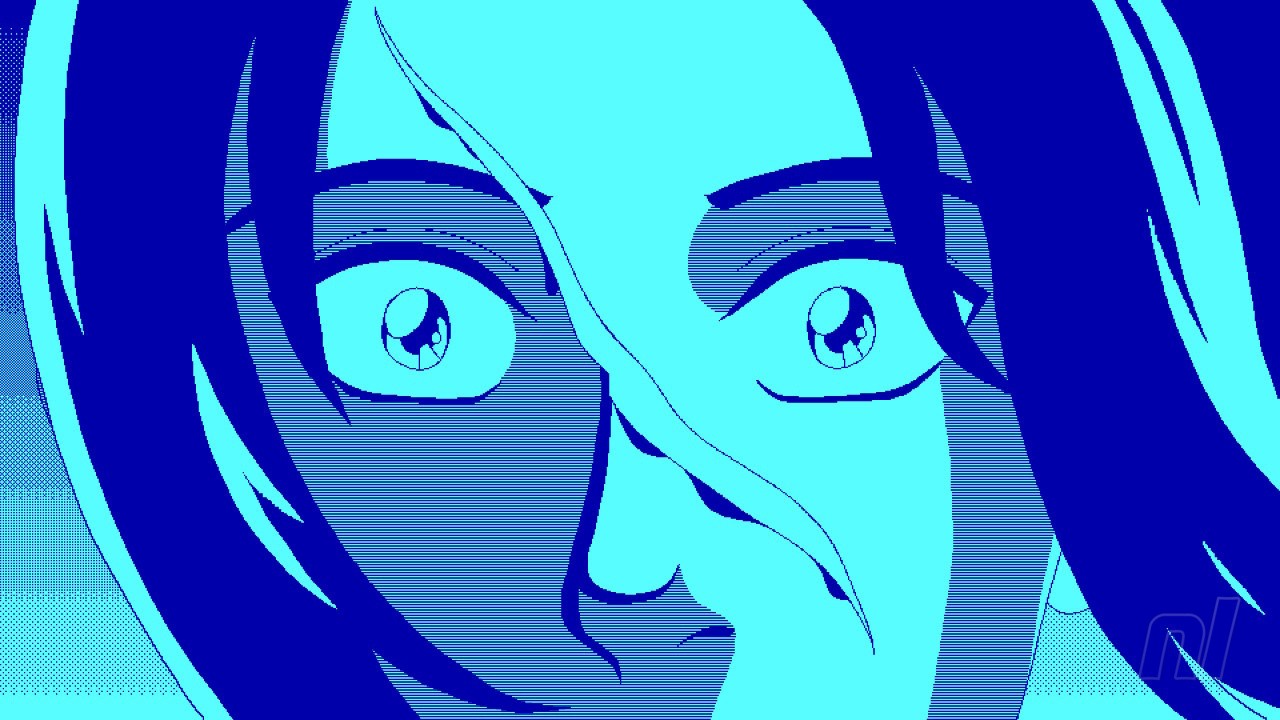
But Emmett’s central relationship with a brand new user, Vivi, who attracts his attention thanks to her fantastic art, is the central story here, and it's strong enough to pull you through any input irritations. The two form a friendship which starts off awkward and shy but blossoms into something affirming. I had a friendship just like Emmett does with Vivi, though it was with someone I knew in real life. We spoke almost exclusively through MSN Messenger (remember that?) despite living in the same town and going to different schools, but we’d write stories together, talk about life, what we were reading, listening to, playing…I miss it
It's for this reason that Vivi’s character and her relationship with Emmett hit me the hardest. Not knowing whether you’ve upset someone, said the wrong thing, or not knowing what's going on in someone's life that you care about is heartbreaking, and the game captures that perfectly. The writing is already excellent throughout, but it’s between these two where it truly delivers, shining yet another light on what community and video games can really do for people.
Do I wish some of Emmett's other relationships had that same depth? A little! MarKun666, for instance, is the Feudal Fantasy fan; Emmett and him have met in real life and are close, always encouraging each other and having fun. But it rarely goes beyond that. Zalor, meanwhile, is having trouble with his online girlfriend Tifa-Chan, and by the end it feels like that whole situation gets swept under the rug.
But that’s a part of life, right? People move on, and sometimes you never find out what happened to those you spent hours chatting with or reading posts from. I’ve lost contact with many friends I’ve made online, and it’s a scary reminder of the ephemerality of the digital world. But those connections can last outside of that space, and — most importantly — their impact certainly does.
I wouldn’t be where I am today without those hours-long chats on Messenger. I wouldn’t have a job writing about video games if I hadn't played RuneScape online or discussed Tales of Symphonia with like-minded strangers on message boards. The internet may feel like a black hole of hate and AI-generated content in 2025, and the games industry is rife with layoffs and accusations of workplace abuse, but I cling to the hope and the human relationships I’ve formed in both of these spaces. Behind every avatar is a human, and Videoverse clings to that very same notion.
Conclusion
Videoverse is a perfect time capsule of early online communities, never shying away from difficult topics and always approaching them with a smile. Its nostalgic wrapping works wonders for Millennials who grew up with a mouse or console in hand and who have made friends online.
While I wish there were a few more chats with other characters, and the Switch may not be the best place to experience it due to input frustrations, Videoverse is a tonic for the soul that the online world needs now more than ever.


Comments 10
Thanks for the review, definitely interested in giving this a try myself at some point - seems like a great reminder that we could and should be nicer to each other on the internet in general and such online communities in particular (of course nobody is perfect and so we can all make mistakes from time to time, me included as much as I've been striving to do that here on Nintendo Life and elsewhere, but still)!
Sounds interesting, I love the Miiverse inspiration!
"I know artists who use subtlety, their ***** COWARDS" - The dev who decided the next gen console should be called Dolphin
Why, that sounds like my era of internet! Color me intrigued.
@Zeebor15
@VoodooTrumpet I'm not sure what emotion that gif is
@Zeebor15 its all of them
Controls feel better suited to a mouse and keyboard? It's just like miiverse as I remember it then, haha!
Hopefully there's a subplot that nods to the romantic Miiverse saga of Allan and Nicole.
I read this after reading the review for Blippo+, and now I NEED to play them both so that I can relive around half of my life.
Show Comments
Leave A Comment
Hold on there, you need to login to post a comment...