 by

The Legend of Zelda: Ocarina of Time is a masterpiece. An enduring classic that set the standard, and often the template, for virtually every single action-adventure game that followed in its footsteps.
A cultural touchstone for a generation, there are references to it littered throughout its gaming descendants and beyond, but there will now be an entirely new generation of player preparing to embark upon this chapter of the Zelda story - a good chunk of whom will have only experienced a Zelda title post-N64 (or no Zelda at all).
Which begs the question: will all those many, many references finally fall into place for them, like a well-constructed block-pushing puzzle?
It would be impossible to track it across all of gaming, of course, so instead we have listed some of our favourite and most obscure callbacks to the Ocarina of Time in the mainline Zelda games that came after. Grab a fresh cup of Lon Lon Milk for the read - there are a lot of them…
Majora’s Mask (N64 & 3DS)
A bit of a false start, this, as essentially the entire game is a reference, utilising many of the same assets as its predecessor. But the story confirms Link isn’t the only person to make the trip from Hyrule to Termina - the game’s antagonist, Skull Kid, and The Happy Mask Salesman both recognise Link and mention his previous exploits.
Anju’s Grandmother is Granny in OoT, a different character who runs the potion shop and strokes a tiger cub in Hyrule. The tiger doesn’t make the jump to Termina, but there is a tiger portrait adorning the back of her wheelchair.
The 3DS adds a few more details. In the fishing hole, you can catch Lord Chapu-Chapu, a reference to OoT's giant fish/dungeon using a miniaturised version of its character model. And Ganondorf may be absent, but you can find a stuffed plushie of his horse on the floor in Romani’s Ranch.
A Link to the Past & Four Swords (GBA)
A tiny one, this.
After OoT released and canonically established itself as the Sealing War referenced in A Link to the Past’s manual, the opening text was changed in the GBA re-release from ‘seven wise men’ to ‘seven sages’ to directly reference the sages encountered in Ocarina of Time. Neat!
Wind Waker (Gamecube/Wii U)
Wind Waker is positively awash with references, so let’s tackle some obscure ones.
A lot of musical themes, phrases and variations are used, and though Outset Island, where Link starts his adventure, has its own theme, it features a phrase lifted straight out of Kokiri Forest.
The Water Spirit Jabun’s theme is a callback to the theme inside Lord Jabu-Jabu (minus his tummy grumbles); however, a cheeky nod to the Great Deku Tree lies within the Sacred Shrines dotted around the great sea. The theme inside these is a variation on Link’s first OoT dungeon.
Speaking of smaller islands, the Goddess Statues on the Triangle Islands bear inscriptions on their bases which translate to Din’s Fire, Nauru’s Love, and Farore’s Wind - the spells Link can summon in OoT.
Ganondorf and the Great Deku Tree are canonically the same characters (the latter having grown from his sprout), but perhaps the most wild callback is a Rito named Koboli. The Nintendo Gallery within Wind Waker states that he is descended from three generations of Postmen and had an ancestor who was one. Take a close look and you can see that his face is modelled after the postman in Majora's Mask, who is of course the running man in OoT.
The Nintendo Gallery houses some more of our favourite easter eggs. There are bottles of Lon Lon Milk as well as the Bunny Hood and Keaton Mask up on the wall, but just behind the desk to the left is an unfinished bust of a character - the face shape and hairstyle clearly indicate this is a bust of the Kokiri sage, Saria.
That’s far from the only nod to the sages. The Master Sword chamber’s stained glass windows are pretty well known, but Wind Waker’s Kokiri sage Fado is also named after the girl who sits above the shop in Kokiri Forest. His role as the Sage of Wind is another nod to OoT, as the Forest Temple was originally intended to be the Wind Temple, something you can still see in the game by the medallion featuring a fan blade pattern.
The other sage, Medli, is a descendant of the Zora. Like Ruto was to Lord Jabu-Jabu, Medli is the attendant to the Rito's deity, Valoo, and the dungeon has Link haul Medli around above his head, just as you did with Princess Ruto.
To finish on a fun one, Wind Waker once again gives Link the ability to use a glass bottle to deflect Phantom Ganon’s energy balls back at him during Dead Man’s Volley, just like you could in OoT!
Minish Cap (GBA)
There seems to be a pattern of the top-down 2D games paying greater tribute to A Link to the Past. Nevertheless, Minish Cap does feature a few OoT nods.
There are a couple of audio callbacks that are really tricky to catch - the Kokiri Forest theme is remixed here to form the Hyrule Town music, while Link’s voice also samples child Link from OoT.
Popular characters return. As does Dampé. And there are some carpenters and builders in Minish Cap that share the design aesthetic from the carpenters on the N64.
A nice thematic nod is the set-piece routine of rescuing Princess Zelda after battling Vaati, only to have to escort her out as the castle crumbles down around you both. Subtle, but undeniable.
Twilight Princess (Gamecube/Wii/Wii U)
The obvious one here is that the overworld map very closely resembles the Ocarina's Hyrule. The Forest, Death Mountain, Lake Hylia, and Gerudo Desert all return and are more or less where you’d expect them to be, though you may not have caught this if, like so many of us, you played Twilight Princess on the Wii first (it mirrored the game world so East became West).
Three of the game’s Light Spirits — Eldin, Lanayru, and Faron — are named after the Hylian Goddesses, who themselves are depicted in a carving above Zelda’s throne portraying the creation myth from OoT's cutscene.
Ganondorf is, yet again, the same Ganondorf you fought in OoT and there’s a few other cool character nods, too. Skull Kid in the Lost Woods is accompanied by Saria’s Song, the same piece you taught Skull Kid in OoT, and Majora’s Mask antagonist. A popular fan theory is that he returned to Hyrule and, possibly being an immortal creature, agreed to guard the Master Sword for his good friend who helped him in Termina.
The fishing hole in Hyrule is run by Hena, the descendant of the owner of the fishing hole in OoT, of whom there is a black-and-white portrait behind the desk. She even has the same itchy back affliction shared by her forefather.
The White Wolf/Heroes Shade is the deceased, spectral reincarnation of the Hero of Time from OoT, which explains why the Howling Stones it gets you to use feature both the Prelude of Light and the Requiem of Spirit.
These are many more musical references, including the Serenade of Water playing whenever you talk to Rutella, Queen of the Zora, but she and her son, Prince Ralis, also sport necklaces featuring a pendant that resembles the Zora Sapphire.
Oh, and we can once again enjoy a game of Dead Man’s Volley with an empty bottle. Huzzah!
Phantom Hourglass & Spirit Tracks (DS)
Where Wind Waker was stuffed with OoT callbacks, its DS sequels are substantially less so. However, a fairy companion returns for this game and shares the same design as Navi. Gossip Stones made an appearance, too.
The A Spirit Opens the Way track is a variation of the Creation of Hyrule theme from OoT - not one that’s sampled often. I also maintain that Spirit Tracks' Dungeon Gauntlet theme is a remix of the Battle theme that plays during the fight with Gohma, but someone with a better ear might disagree.
Skyward Sword (Wii/Switch)
Being a game that launched on the 25th anniversary of the Zelda series, Skyward Sword has some choice OoT nods.
Just like the DS pair of games, the Gossip Stones are back, but this time they share a secret with OoT: flinging a bomb at one will cause it to count down and launch into the air like a rocket.
Loftwings, the bird companions of the game, are a callback/forward to OoT’s iconic Hylian Shield - in particular Link’s red Loftwing, which matches the hue of the bird on the shield’s front.
A strong visual nod occurs once the Isle of the Goddess falls into the Sealed Grounds. Looking up into the ceiling of the newly formed Sealed Temple reveals a mural of the Triforce surrounded by the sage medallions, which in itself bears a striking resemblance to the Chamber of Sages Link returns to after clearing a temple.
In this game, Zelda hands over a precious, magical instrument to Link before her own power awakens later on in the game, just like Zelda in OoT.
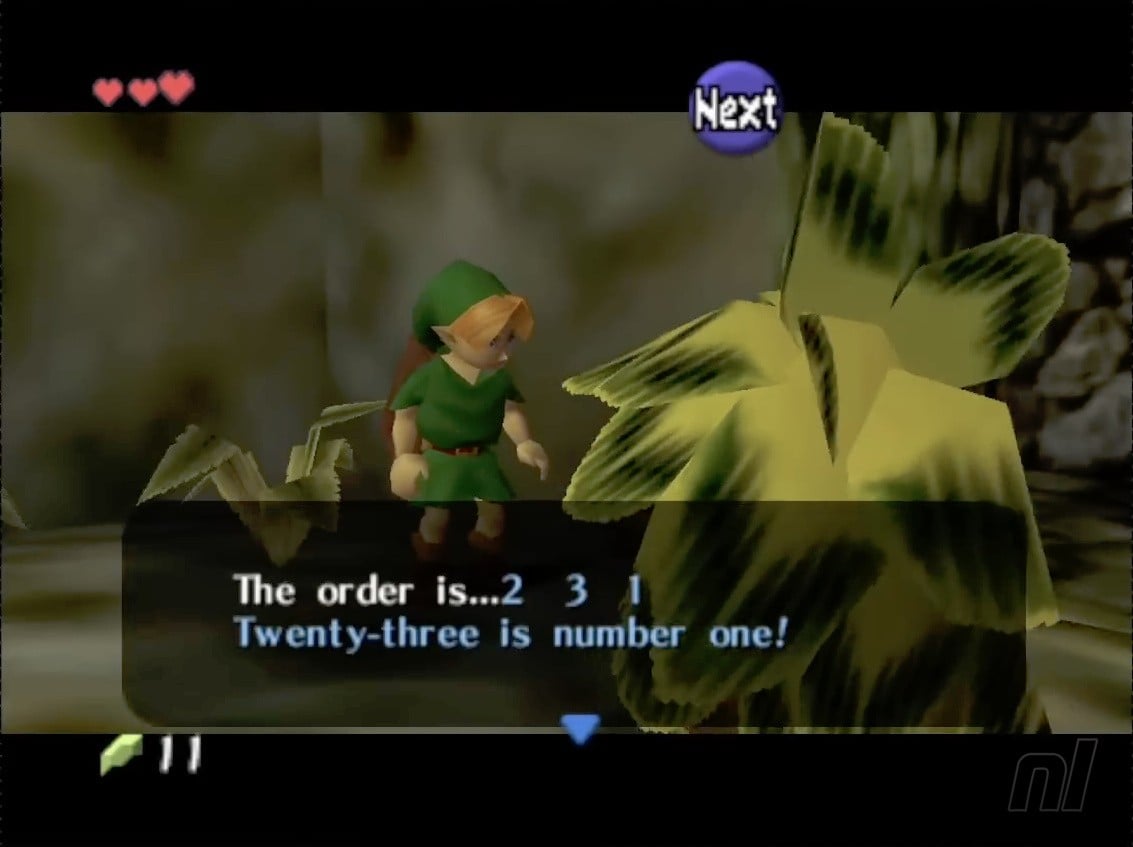
Lastly, a puzzle and thematic callback. The Lanayru Mining Facility contains a puzzle where you have to hit three switches in a specific order — 2, 3, 1 — a reference to the final puzzle of OoT’s Great Deku Tree. “23 is number 1!”
A Link Between Worlds (3DS)
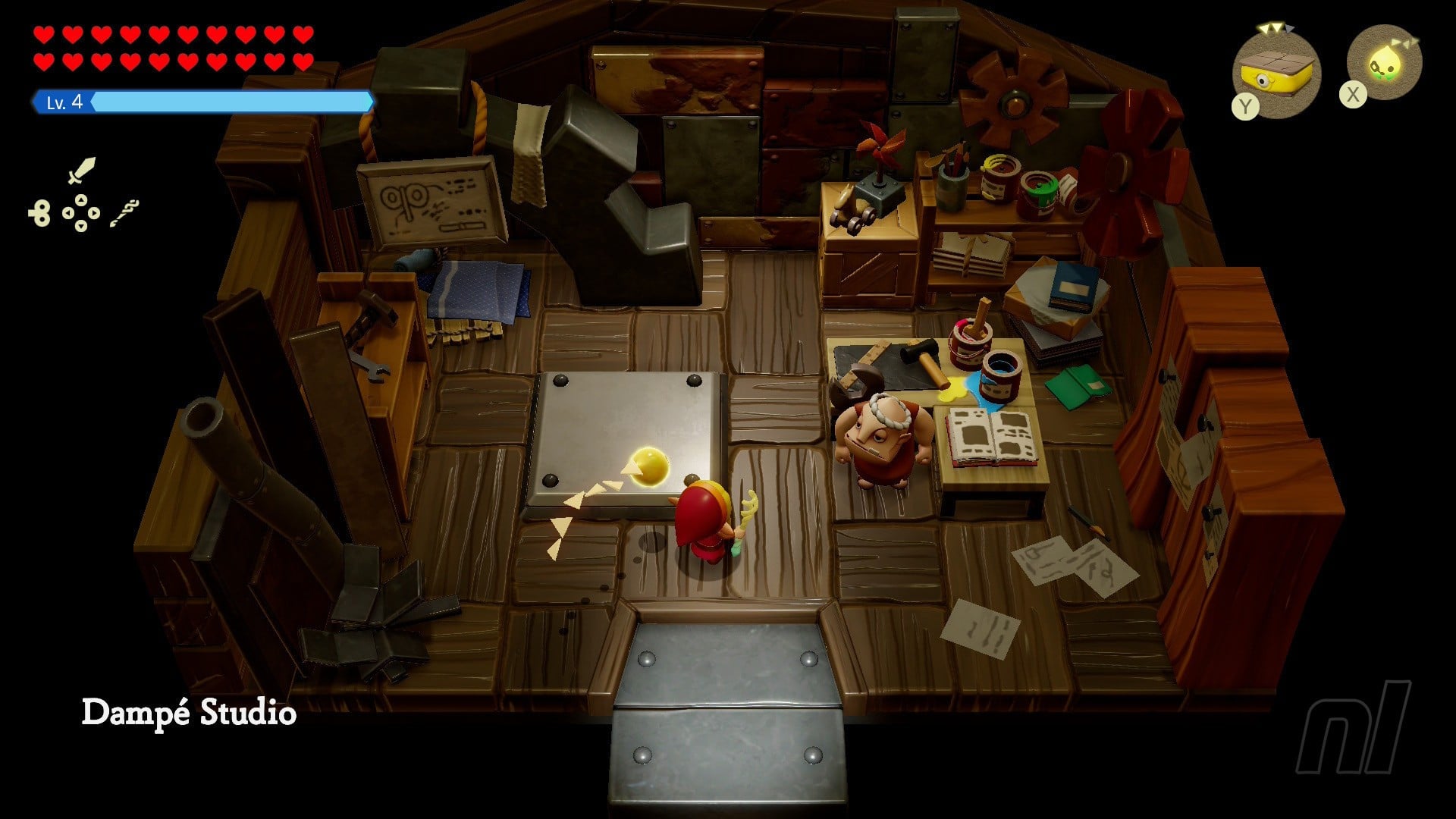
A few characters pop up here, with Dampé appearing again, not once, but twice. He’s his own parallel in both Hyrule and Lorule.
Hyrule’s unnamed Milk Bar owner also bears a striking resemblance to Talon, while his Lorule counterpart looks suspiciously like Ingo.
Two pieces of art reference OoT: a painting of a fairy design like Navi’s adorning the wall of the Stylish Woman’s House, while a small, yellowish Ocarina is on Link's wall. Easy to miss, as you need to merge into the wall to find them.
Tri Force Heroes (3DS)
If you dash into a wall within the level lobby, there’s a chance it will drop a purple ball down. Give it a whack with your sword and you have a chance of hearing the Lost Woods theme, Zelda’s Lullaby, the Lon Lon Ranch theme or Kakariko’s Windmill theme. They only play while you juggle the ball with sword hits - once it hits the floor, it’s done!
My favourite, though, is that Link is assigned voice clips from one of four Zelda games when you create a save file. So there’s a 25% chance you’ll be hearing the guttural shouts of OoT Link while you play.
Breath of the Wild (Wii U/Switch)
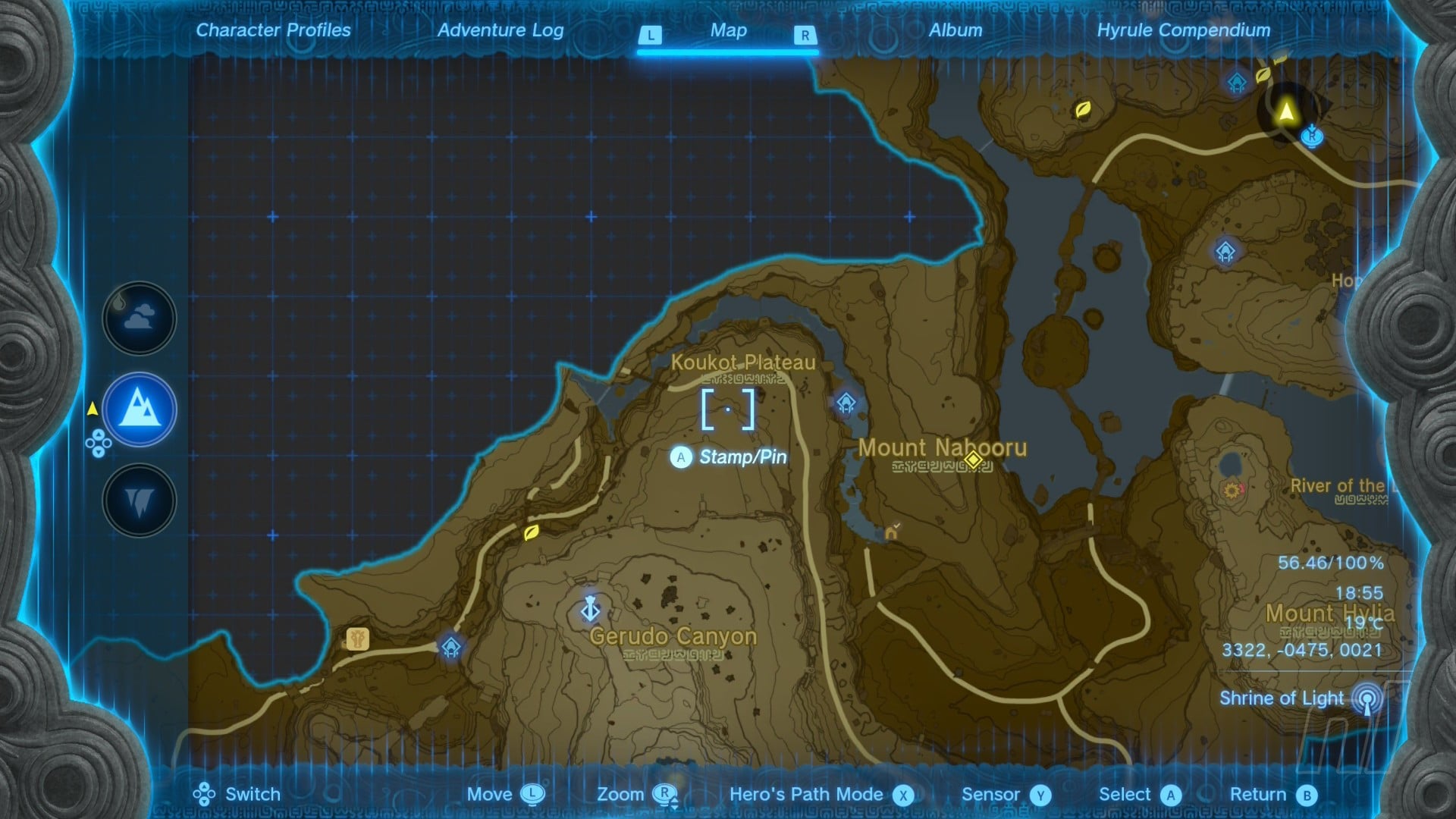
Breath of the Wild's vast map is heaving with references to other Zelda games. There’s some obvious callbacks like Ruto Lake, Mido Swamp, and Mount Nabooru, but perhaps the best callback is Koukot Plateau by the Gerudo Desert - named, fittingly, as a portmanteau of Kotake and Koume.
Eldin, Faron, and Lanayru have been used in reference to the Goddesses before, but the dragons Dinraal, Farosh, and Naydra are also named after OoT’s deities.
The Temple of Time on the Great Plateau is the classic structure from OoT, even playing the same theme inside, but a sneakier callback lies within the Ranch Ruins just south of Hyrule Castle, which perfectly mirrors the race track and layout of Lon Lon Ranch.
Some of the clothing and weapons in the game, particularly the DLC sets, straight up lift costumes from OoT, but a sneakier nod is the design of the Forest Dweller's Sword, based on the Kokiri Sword, and is even clearer to see in the upcoming remake.
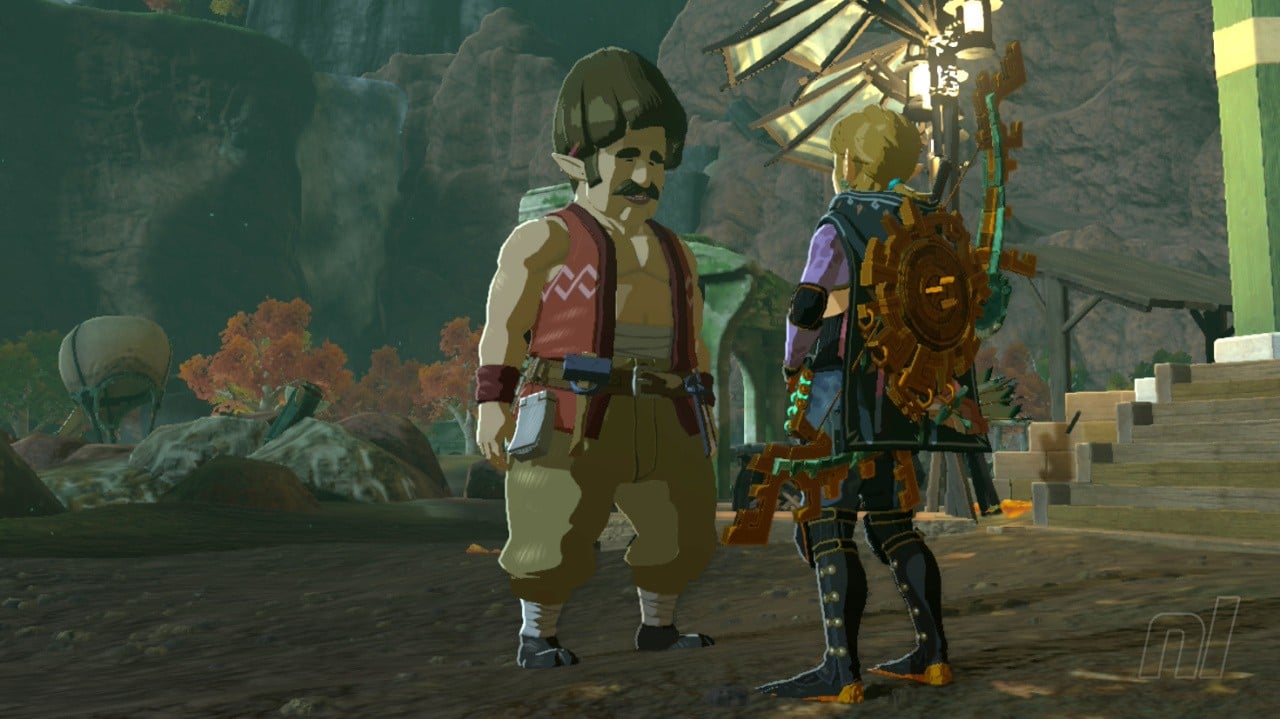
And my favourite costume nod doesn’t belong to Link. Hudson, a man who builds houses from the ground up, is modelled on the carpenters in OoT.
There’s plenty of musical references, too, including one you can see but not hear. Above the throne in Hyrule Castle, there’s a Triforce surrounded by concentric rings with round dots placed along them. On closer inspection, these rings actually form a musical stave, with the dots being the notes for Zelda’s Lullaby that you learned in OoT. Incredible nod.
Link’s Awakening (Switch)
An incredibly faithful remake of the Game Boy original that predates OoT, the Switch version nevertheless manages to add a few nods.
Dampé is back. At this point it feels like he’s in more games than Link?
When fighting Shadow Nightmare, the ability to play Dead Man’s Volley with Agahnim’s Shadow has been retroactively added, too.
Tears of the Kingdom (Switch)
Building on the incredible reference work of BOTW, Link can now hum any of the following while cooking: Saria’s Song, Epona’s Song, or the Song of Storms, while the House theme returns for Link’s home.
The flute player Pyper raises his legs to the side in turn as he plays, a direct callback to the flute-playing skull kids in the Lost Woods.
Cutscenes deliberately evoke previous OoT ones here. Zelda’s turn and gasp in the opening, with her right hand to her mouth, is an homage to her seeing Link for the first time in OoT, while the memory A Show of Fealty mirrors what Zelda sees through the window in that very same scene - Ganondorf kneeling before the King while swearing a false oath.
Though not named, Ganondorf is also flanked by Kotake and Koume in the above and other scenes, distinguishable by the gems on their forehead and the cloths on their shoulder matching their OoT headbands.
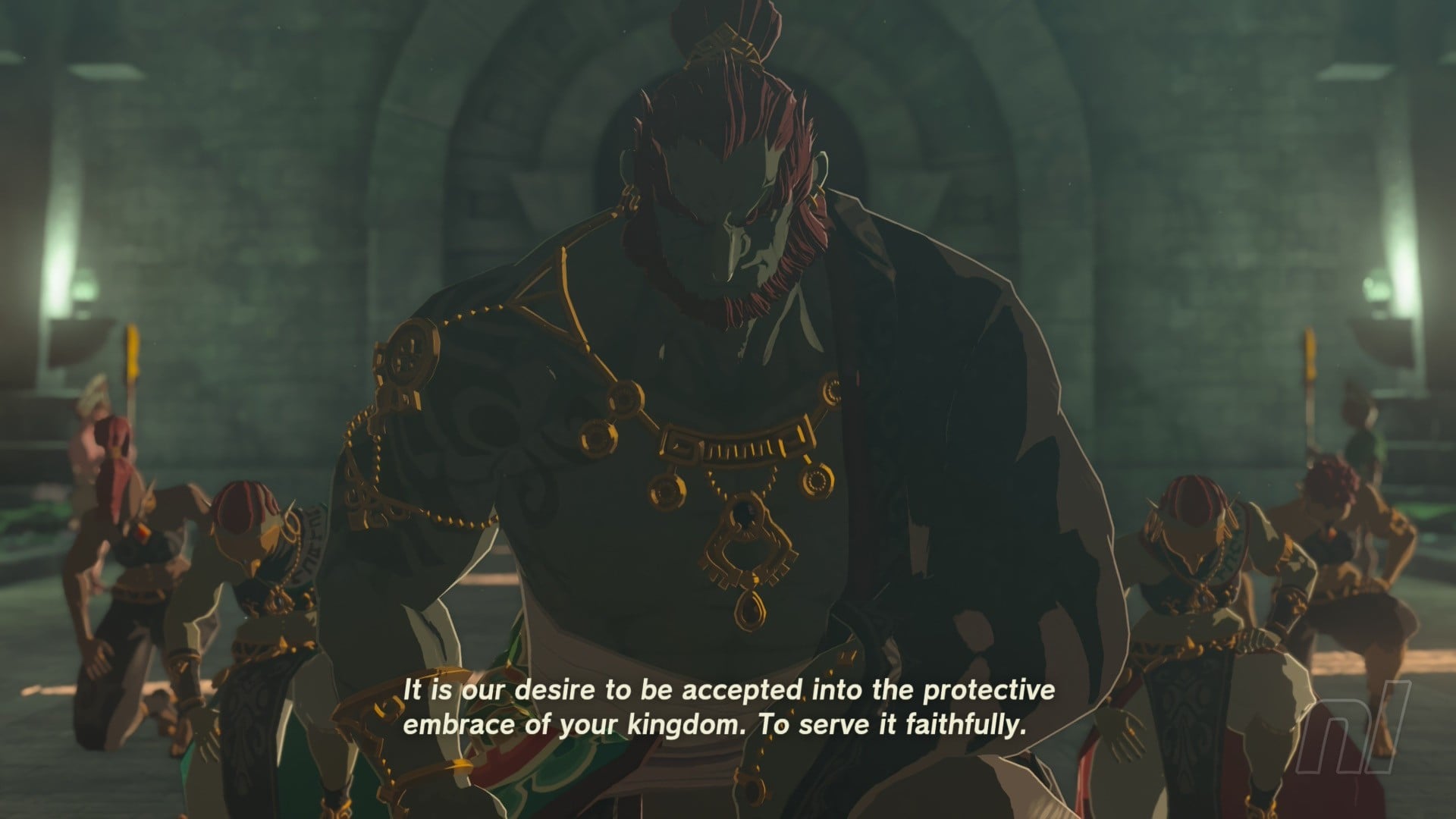
Some conceptual nods include Ganondorf being imprisoned and sealed by seven sages, while the adventure sees Hyrule Castle raised up high above a red, ominous pit, just as it is once Link travels into the future in Ocarina of Time.
Echoes of Wisdom (Switch)
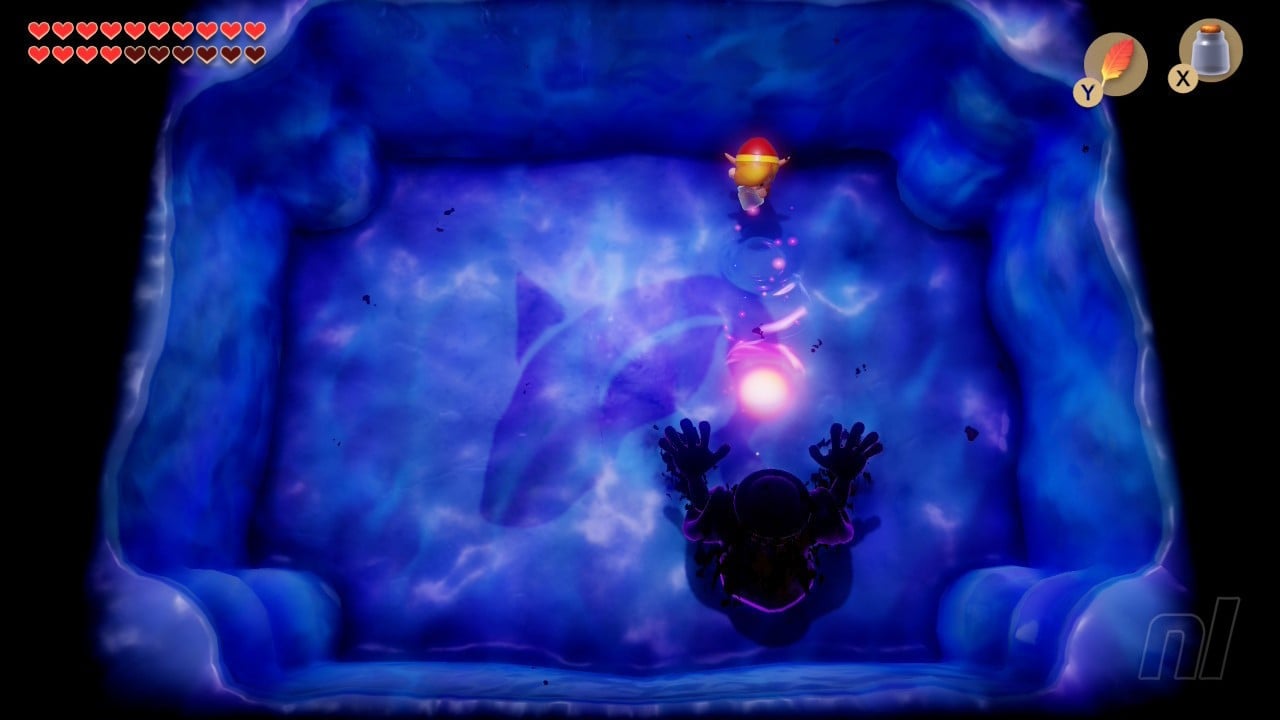
Echoes of Wisdom’s opening cutscene deliberately evokes the climax of OoT (which itself evoked past games) before switching things up, with Zelda trapped in a purple crystal and held aloft, but the whole game also heavily references the creation of myth from OoT while expanding upon it.
Kakariko Village, although appearing in several 2D Zelda games, specifically features a windmill, a graveyard, and a well (although it is covered) for the first time since OoT.
And finally, you’ve guessed it. Dampé.
If I could turn back time
So that’s it: our favourite and most obscure Ocarina of Time nods, references, and easter eggs across the Zelda series.
There are many others, of course, and in other games. The Oracle duo, for instance, are packed with characters from Ocarina of Time - most notably giving human form to the Golden Goddesses for the first time, while also fleshing out Kotake and Koume. Elsewhere, Kaepora Gaebora, Malon and Talon, and Dampé (of all people) returned in Four Swords Adventures. As did Epona! Curiously also split into four, somehow.
There are so many references that this article was literally double the word count on draft one! But which reference is your favourite? Is there another we should’ve included? If so, give us a ‘Hey, Listen!’ in the comments below.
And before we go, a big shoutout to Zeltik, DPadGamer, A Dan in Time, Triforce Times, DidYouKnowGaming, Zelda Dungeon, Zelda Wiki, and Kevin Armes Music for their incredible work cataloguing Easter Eggs across the Zelda series.


Comments 17
What about the temple of time in Skyward sword? I always saw it like a building site for what would become the temple of time in OOT. The stones that turn back time when you hit them with your sword to me seems to be some explanation of how the temple of time works in oot.
Basically all of Twilight Princess is a reference to OoT.
Great refresher of most of these references and Easter Eggs (a couple I straight up didn't know) - looking forward to seeing which Zelda ones in general will be in the Ocarina remake!
@SuperPaulio I couldn’t say if that was a direct one, to be honest, but I love that theory. I bought the switch version but still need to finish it!
@ButterCashier yes! Although I was surprised to find that Wind Waker is more packed with references than TP. I think it does a good job at carving out its own identity while closely aligning with its inspiration?
@JohnnyMind oh that’s an interesting thought. I wonder if there’ll be some retroactively added. It wouldn’t surprise me if Majora’s mask is buried somewhere in the happy mask shop!
This is a great article, which funnily enough, makes me pine for Twilight Princess to come to Switch 2 some day. It’s the only mainline Zelda that’s not playable on the new system and a game I’ve never actually played. At least add it to NSO, Nintendo!
Like so many Nintendo fans, I had hope that Wind Waker HD would be ported over at some point, but I don’t think that’s likely to happen now. I guess I need to get the NSO Expansion Pack so I can play it for the first time since it released on Wii U. Sure, it doesn’t have 16:9 widescreen, but the NSO screenshots in this very article look really clean. I’m definitely gonna get to it sometime after I’m done with Ocarina. Only a couple more days to go!
The three shrines Zelda had to visit to try and awaken her power in the memories of BotW looks visually a lot like the shrines the Zelda from SS had to visit at the end of each dungeon to awaken the memories of her 'past life'.
While not a reference to another Zelda but another Nintendo game, the three statues prior to receiving Din's, Farore's and Nayru's pearls are based on pikmins down to their goddess' primary color: Din's has a nose, Farore's has ears and Nayru's has a crack that resembles a mouth, and they all sport a funny appendage on top of their heads
Edit- okay, I misread the article's intentions. They are mentioning only references to OoT in other games. My bad
Great article, I never thought about the totk throne room memory being the reverse of the iconic oot scene, but now it seems obvious!
Good article. I was thrown off at first, thinking this would be an article of the Threads of Time game 😆
#releasethebankscut
@The_Pixel_King writing this had me thinking about that - and I wonder if they haven’t released it because they knew OOT was coming and it is a game that leans heavily on the structure of its predecessor? They didn’t want people to compare it before experiencing the rerelease?
Whether there’s any merit to that or not, it’ll definitely drop eventually. And it’s a good game, too!
@Bobb no worries! I love everything like that (I knew about the statues - it’s a particularly cool nod).
I was staggered at the volume of references for OOT alone in just the mainline of zelda - I can’t fathom how many there must be across all the games and all of gaming!
@Mjplaysgames I can almost imagine it word for word in OOT
@Markatron84 😂 my email started with
“I’m so sorry I’ve written a dissertation”
Boo. I thought this was going to be about the upcoming indie title Threads of Time.
@Banks Right?!
Thanks again for a fun read!
Show Comments
Leave A Comment
Hold on there, you need to login to post a comment...